
Note
Go to the end to download the full example code or to run this example in your browser via JupyterLite.
Approximating pi by continued fractions#
Expands pi as a continued fraction and shows how quickly its convergents (355/113 famously accurate to 7 digits) approach the true value.
import numpy as np

from mathematicskit.number_theory import best_rational_approximation, continued_fraction_expansion
from mathematicskit.number_theory.visualizers.plots import plot_convergent_errors
Expand pi and inspect its convergents#
result = continued_fraction_expansion(np.pi, max_terms=8)
print("terms:", result.terms)
for p, q in result.convergents:
    print(f"  {p}/{q} = {p / q:.10f}  (error {abs(p / q - np.pi):.2e})")
terms: [3, 7, 15, 1, 292, 1, 1, 1]
  3/1 = 3.0000000000  (error 1.42e-01)
  22/7 = 3.1428571429  (error 1.26e-03)
  333/106 = 3.1415094340  (error 8.32e-05)
  355/113 = 3.1415929204  (error 2.67e-07)
  103993/33102 = 3.1415926530  (error 5.78e-10)
  104348/33215 = 3.1415926539  (error 3.32e-10)
  208341/66317 = 3.1415926535  (error 1.22e-10)
  312689/99532 = 3.1415926536  (error 2.91e-11)
Best approximation under a denominator bound#
best approximation with denominator <= 1000: 355/113
Plot the convergent errors#
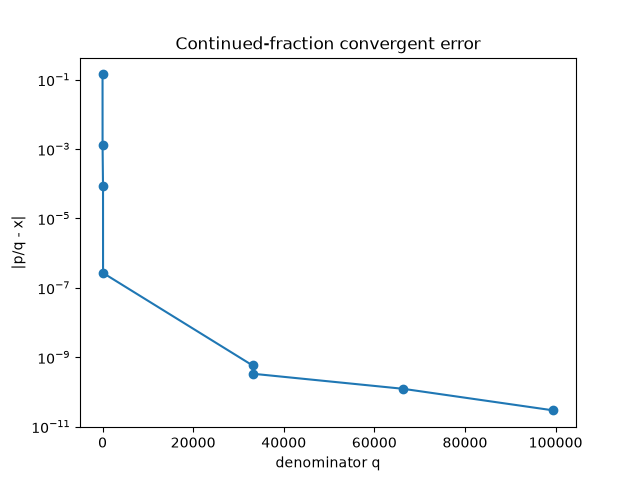
<Axes: title={'center': 'Continued-fraction convergent error'}, xlabel='denominator q', ylabel='|p/q - x|'>
Total running time of the script: (0 minutes 0.031 seconds)
