
Note
Go to the end to download the full example code or to run this example in your browser via JupyterLite.
Gauss’s Disquisitiones: congruences and the remainder theorem#
Gauss’s Disquisitiones Arithmeticae (1801) opens by defining \(a \equiv b \pmod m\) and computing with residues instead of numbers. Its Articles 32-36 prove that congruences with pairwise coprime moduli combine into one: working modulo \(m_1 m_2\) is the same as working modulo \(m_1\) and \(m_2\) at once. This script checks Gauss’s rules of congruence arithmetic, draws the residue grid that pairs each class mod 35 with one class mod 5 and one mod 7, and reduces a huge power with fast modular exponentiation.
import matplotlib.pyplot as plt
import numpy as np

from mathematicskit.number_theory import chinese_remainder_theorem, fast_mod_pow
Congruences respect addition and multiplication#
If \(a \equiv a'\) and \(b \equiv b' \pmod m\), then \(a + b \equiv a' + b'\) and \(ab \equiv a'b'\) (Articles 6-7).
17 = 5 (mod 12): True;  23 = 11 (mod 12): True
sums agree mod 12: 4 = 4;  products agree: 7 = 7
Combining congruences: residues mod 35 = pairs of residues mod 5 and 7#
m1, m2 = 5, 7
grid = np.array([[chinese_remainder_theorem([r1, r2], [m1, m2]).residue for r2 in range(m2)] for r1 in range(m1)])
print("each residue mod 35 appears exactly once:", sorted(grid.ravel().tolist()) == list(range(m1 * m2)))

fig, ax = plt.subplots(figsize=(6, 4.5))
ax.imshow(grid, cmap="viridis", origin="lower")
for r1 in range(m1):
    for r2 in range(m2):
        ax.text(r2, r1, str(grid[r1, r2]), ha="center", va="center", color="black" if grid[r1, r2] > 20 else "white", fontsize=11)
ax.set_xticks(range(m2))
ax.set_yticks(range(m1))
ax.set_xlabel("x mod 7")
ax.set_ylabel("x mod 5")
ax.set_title("Gauss's combination of congruences: x mod 35")
plt.show()
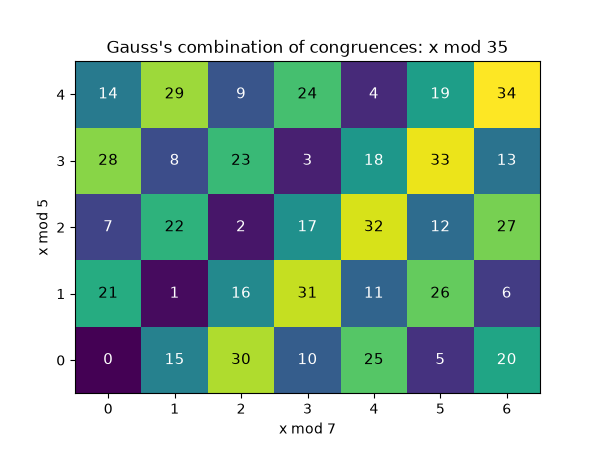
each residue mod 35 appears exactly once: True
Computing with residues: fast modular exponentiation#
\(2^{10^{18}}\) has about \(3 \times 10^{17}\) digits, yet its residue mod 35 follows from about 60 squarings, and agrees with the pair of residues mod 5 and mod 7 recombined.
2^(10^18) = 16 (mod 35); = 1 (mod 5), 2 (mod 7) -> recombined: 16
Total running time of the script: (0 minutes 0.035 seconds)
