
Note
Go to the end to download the full example code or to run this example in your browser via JupyterLite.
Pollard’s rho factorization#
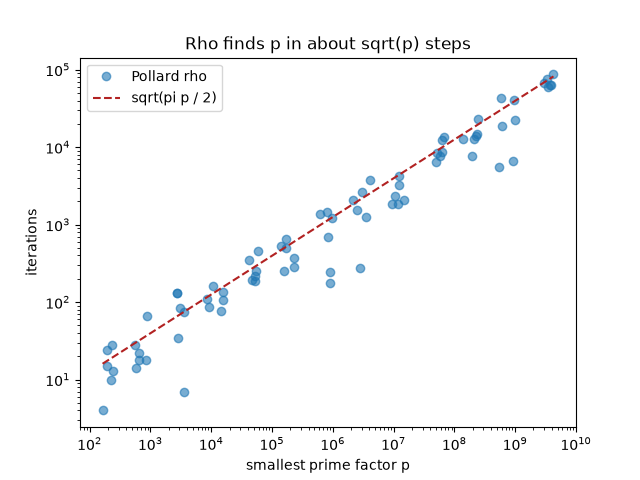
Pollard’s rho method finds a prime factor \(p\) of \(n\) in roughly \(\sqrt p\) steps, by waiting for a birthday-paradox collision in the sequence \(x \mapsto x^2 + 1 \bmod p\). This script factors the Fermat number \(F_6 = 2^{64}+1\) and plots the step count against the smallest prime factor for a batch of semiprimes.
import matplotlib.pyplot as plt
import numpy as np

from mathematicskit.number_theory import is_prime_miller_rabin, pollard_rho
The sixth Fermat number#
result = pollard_rho(2**64 + 1)
print(f"2^64 + 1 = {result.factor} * {result.cofactor}  ({result.iterations} iterations)")
2^64 + 1 = 274177 * 67280421310721 (808 iterations)
Steps grow like the square root of the smallest factor#
rng = np.random.default_rng(0)


def random_prime(lo, hi):
    while True:
        n = int(rng.integers(lo, hi)) | 1
        if is_prime_miller_rabin(n):
            return n


small_factors, steps = [], []
for bits in range(8, 34, 2):
    for _ in range(6):
        p = random_prime(2 ** (bits - 1), 2**bits)
        q = random_prime(2**40, 2**41)
        r = pollard_rho(p * q)
        small_factors.append(min(r.factor, r.cofactor))
        steps.append(r.iterations)
small_factors, steps = np.array(small_factors), np.array(steps)

fig, ax = plt.subplots()
ax.loglog(small_factors, steps, "o", alpha=0.6, label="Pollard rho")
ref = np.logspace(np.log10(small_factors.min()), np.log10(small_factors.max()), 50)
ax.loglog(ref, np.sqrt(np.pi * ref / 2), "--", color="firebrick", label="sqrt(pi p / 2)")
ax.set_xlabel("smallest prime factor p")
ax.set_ylabel("iterations")
ax.set_title("Rho finds p in about sqrt(p) steps")
ax.legend()
plt.show()
Total running time of the script: (0 minutes 0.492 seconds)
