
Note
Go to the end to download the full example code or to run this example in your browser via JupyterLite.
Lagrange’s four-square theorem#
Every non-negative integer is a sum of four squares. This script finds a representation for every \(n < 10{,}000\) and plots the fewest squares each \(n\) actually needs: one for perfect squares, two by Fermat’s criterion, four exactly for \(n = 4^k(8m+7)\) (Legendre’s three-square theorem), and three otherwise.
import math

import matplotlib.pyplot as plt
import numpy as np

from mathematicskit.number_theory import sum_of_four_squares, sum_of_two_squares
Four squares always suffice#
all representations correct: True
  7 = 2^2 + 1^2 + 1^2 + 1^2
  31 = 5^2 + 2^2 + 1^2 + 1^2
  310 = 17^2 + 4^2 + 2^2 + 1^2
  9999 = 99^2 + 14^2 + 1^2 + 1^2
How many squares does each n need?#
def squares_needed(n):
    if math.isqrt(n) ** 2 == n:
        return 1
    if sum_of_two_squares(n) is not None:
        return 2
    while n % 4 == 0:
        n //= 4
    return 4 if n % 8 == 7 else 3


needed = np.array([squares_needed(n) for n in range(1, N)])
for k in (1, 2, 3, 4):
    print(f"n < {N} needing exactly {k} squares: {(needed == k).sum()}")

fig, ax = plt.subplots()
ax.bar([1, 2, 3, 4], [(needed == k).sum() for k in (1, 2, 3, 4)], color="tab:blue")
ax.set_xticks([1, 2, 3, 4])
ax.set_xlabel("fewest squares needed")
ax.set_ylabel(f"count of n < {N}")
ax.set_title("No integer needs more than four squares")
plt.show()
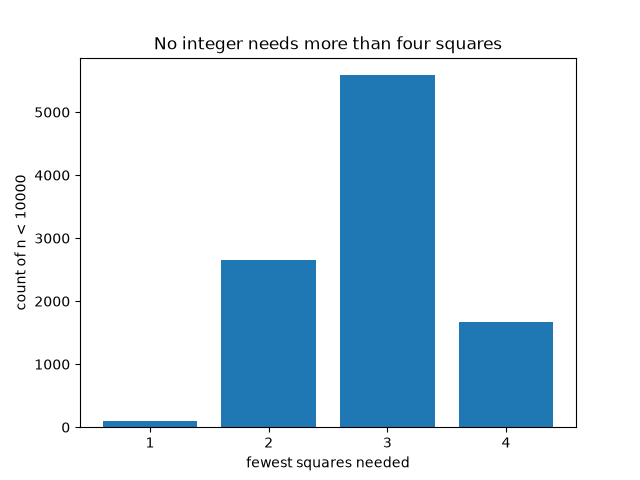
n < 10000 needing exactly 1 squares: 99
n < 10000 needing exactly 2 squares: 2649
n < 10000 needing exactly 3 squares: 5586
n < 10000 needing exactly 4 squares: 1665
Total running time of the script: (0 minutes 0.047 seconds)
