Note
Go to the end to download the full example code or to run this example in your browser via JupyterLite.
Remez’s algorithm and best uniform approximation#
Chebyshev showed that the polynomial of degree \(n\) closest to \(f\) in the maximum norm is characterized by an error curve that reaches its peak magnitude \(n + 2\) times with alternating sign. Evgeny Remez’s 1934 exchange algorithm finds it by repeatedly levelling the error on a set of reference points. This script computes the best degree-6 approximation to \(e^x \sin(3x)\) on \([-1, 1]\) and compares its error with Chebyshev interpolation of the same degree.
import matplotlib.pyplot as plt
import numpy as np

from mathematicskit.numerical_analysis import ChebyshevInterpolant, remez_minimax
The equioscillating error curve#
f = lambda x: np.exp(x) * np.sin(3.0 * x)
n = 6
best = remez_minimax(f, n)
cheb = ChebyshevInterpolant(f, n + 1)  # degree n through n + 1 Chebyshev points

x = np.linspace(-1.0, 1.0, 1000)
err_best = f(x) - best.evaluate(x)
err_cheb = f(x) - cheb(x)

fig, ax = plt.subplots(figsize=(7, 4.5))
ax.plot(x, err_cheb, color="steelblue", label="Chebyshev interpolant")
ax.plot(x, err_best, color="firebrick", label="Remez minimax")
ax.scatter(best.reference, f(best.reference) - best.evaluate(best.reference), color="firebrick", zorder=3, label="reference points")
ax.axhline(best.max_error, color="gray", ls="--", lw=0.8)
ax.axhline(-best.max_error, color="gray", ls="--", lw=0.8)
ax.set_title(f"Degree {n}: the minimax error equioscillates at {n + 2} points")
ax.legend(fontsize=8)
fig.tight_layout()

print(f"Remez: {best.iterations} exchanges, max error {best.max_error:.3e}")
print(f"Chebyshev interpolation: max error {np.max(np.abs(err_cheb)):.3e}")

plt.show()
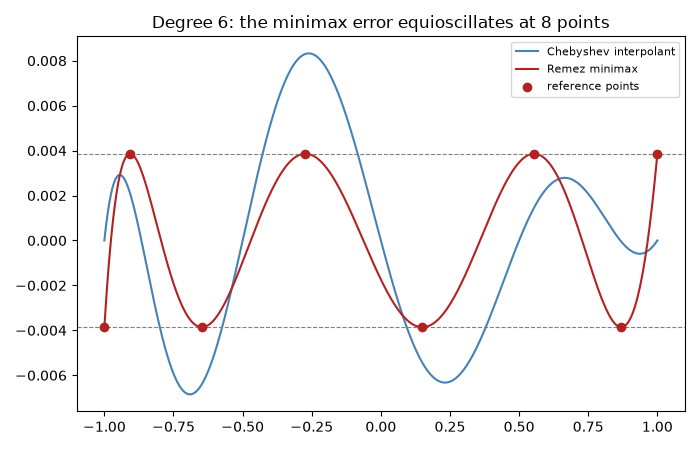
Remez: 4 exchanges, max error 3.860e-03
Chebyshev interpolation: max error 8.326e-03
Total running time of the script: (0 minutes 0.058 seconds)
