Note
Go to the end to download the full example code or to run this example in your browser via JupyterLite.
Nelder-Mead: minimizing without derivatives#
The Nelder-Mead simplex method uses function values only. On the Rosenbrock function it needs more function evaluations than BFGS, which uses gradients, but it also works on objectives that have no gradient at all.
from mathematicskit.optimization import BFGS, NelderMead, rosenbrock, rosenbrock_grad
from mathematicskit.optimization.visualizers.plots import plot_contour_path
Nelder-Mead vs. BFGS on the Rosenbrock function#
x0 = [-1.2, 1.0]
nm = NelderMead(tol=1e-8, max_iter=5000).minimize(rosenbrock, None, x0)
bfgs = BFGS(tol=1e-8).minimize(rosenbrock, rosenbrock_grad, x0)
print(f"Nelder-Mead: x = {nm.x.round(6)}, {nm.iterations} iterations, {nm.extra['nfev']} function evaluations")
print(f"BFGS:        x = {bfgs.x.round(6)}, {bfgs.iterations} iterations")

ax = plot_contour_path(rosenbrock, nm, x_range=(-2.0, 2.0), y_range=(-1.0, 3.0), label="Nelder-Mead (1965)")
plot_contour_path(rosenbrock, bfgs, ax=ax, x_range=(-2.0, 2.0), y_range=(-1.0, 3.0), label="BFGS")
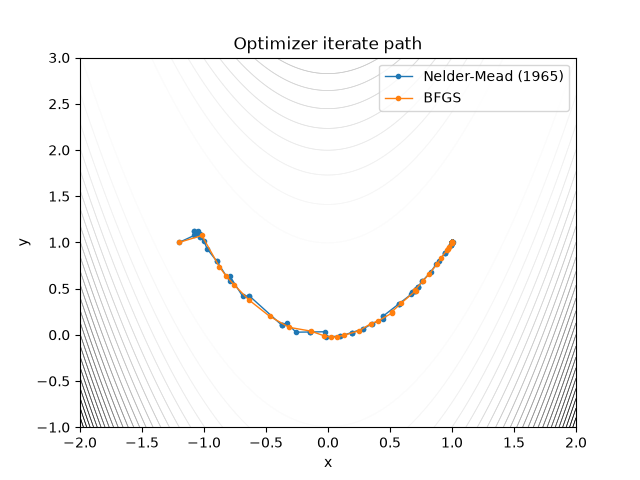
Nelder-Mead: x = [1. 1.], 117 iterations, 219 function evaluations
BFGS:        x = [1. 1.], 34 iterations

<Axes: title={'center': 'Optimizer iterate path'}, xlabel='x', ylabel='y'>
A non-smooth objective#
result = NelderMead(tol=1e-10).minimize(lambda x: abs(x[0] - 1.0) + 2.0 * abs(x[1] + 0.5), None, [0.0, 0.0])
print(f"minimizer of |x - 1| + 2|y + 0.5|: {result.x.round(6)}")
minimizer of |x - 1| + 2|y + 0.5|: [ 1. -0.5]
Total running time of the script: (0 minutes 0.255 seconds)
