
Note
Go to the end to download the full example code or to run this example in your browser via JupyterLite.
Bellman’s principle of optimality: the 0/1 knapsack#
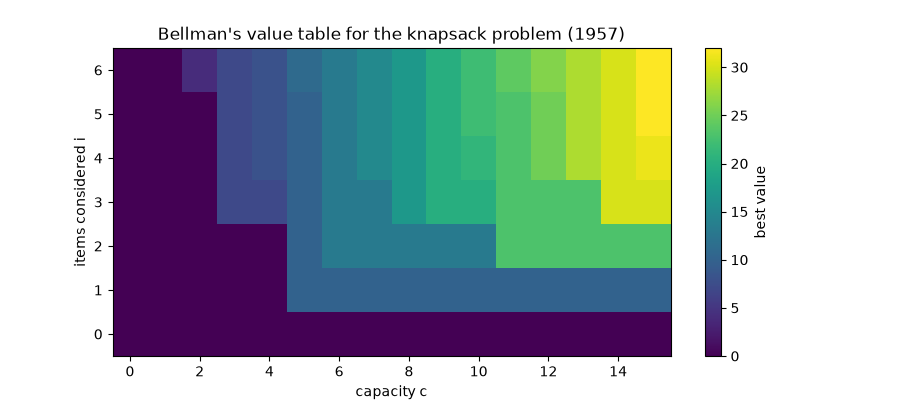
Fills a table of optimal values for every prefix of the items and every capacity, then traces back the chosen items. The table is the dynamic-programming “value function”.
import matplotlib.pyplot as plt

from mathematicskit.optimization import knapsack
Six items, capacity 15#
best value 32 using items [0, 2, 4] (total weight 15)
The value table V(i, c)#
fig, ax = plt.subplots(figsize=(9, 4))
im = ax.imshow(result.table, cmap="viridis", aspect="auto", origin="lower")
fig.colorbar(im, ax=ax, label="best value")
ax.set_xlabel("capacity c")
ax.set_ylabel("items considered i")
ax.set_title("Bellman's value table for the knapsack problem (1957)")
Text(0.5, 1.0, "Bellman's value table for the knapsack problem (1957)")
Total running time of the script: (0 minutes 0.035 seconds)
