
Note
Go to the end to download the full example code or to run this example in your browser via JupyterLite.
Fixed step vs. backtracking line search on an ill-conditioned bowl#
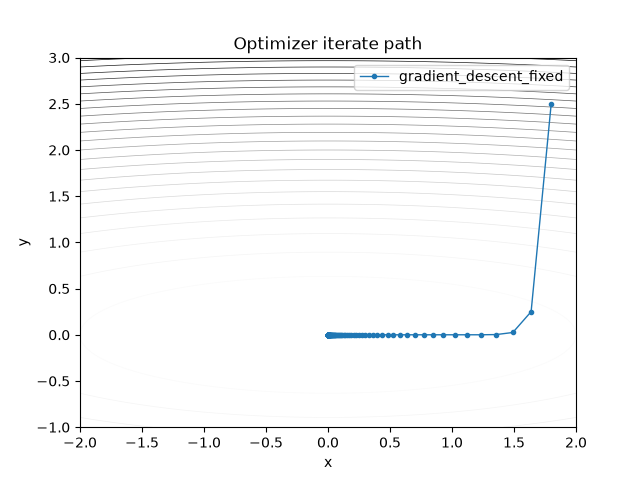
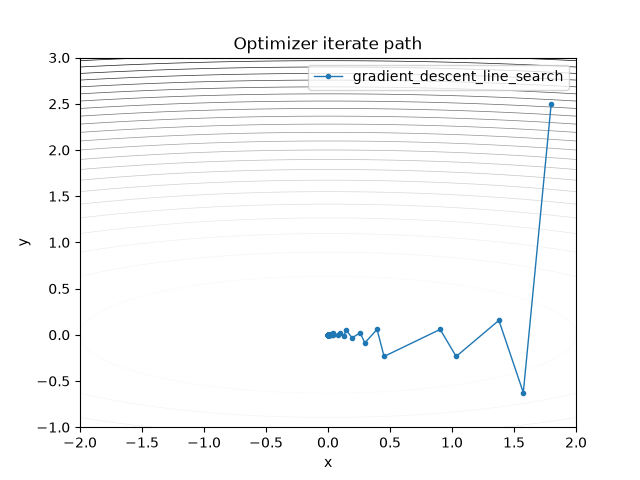
Gradient descent zig-zags across a narrow, elongated quadratic bowl. Backtracking line search adapts its step length automatically and converges in far fewer iterations than any single fixed step size.
from mathematicskit.optimization import GradientDescent, GradientDescentLineSearch, quadratic_bowl, quadratic_bowl_grad
from mathematicskit.optimization.visualizers.plots import plot_contour_path
Run both methods from the same starting point#
x0 = [1.8, 2.5]
result_fixed = GradientDescent(alpha=0.09, tol=1e-8, max_iter=5000).minimize(quadratic_bowl, quadratic_bowl_grad, x0)
result_ls = GradientDescentLineSearch(tol=1e-8, max_iter=5000).minimize(quadratic_bowl, quadratic_bowl_grad, x0)

print(f"fixed step:   {result_fixed.iterations} iterations, x = {result_fixed.x}")
print(f"line search:  {result_ls.iterations} iterations, x = {result_ls.x}")
fixed step:   202 iterations, x = [9.58591898e-009 2.50000000e-202]
line search:  76 iterations, x = [4.24022886e-09 5.38868804e-10]
Plot both iterate paths over the bowl’s contours#
plot_contour_path(quadratic_bowl, result_fixed, x_range=(-2.0, 2.0), y_range=(-1.0, 3.0))
plot_contour_path(quadratic_bowl, result_ls, x_range=(-2.0, 2.0), y_range=(-1.0, 3.0))
<Axes: title={'center': 'Optimizer iterate path'}, xlabel='x', ylabel='y'>
Total running time of the script: (0 minutes 0.314 seconds)
