
Note
Go to the end to download the full example code or to run this example in your browser via JupyterLite.
Erlang’s loss formula: how many telephone lines?#
For Poisson call arrivals offering \(A\) erlangs of traffic to \(c\) lines, a call is lost with probability \(B(c, A)\). Erlang’s formula answers the engineer’s question: how many lines keep losses below 1%?
import matplotlib.pyplot as plt
import numpy as np

from mathematicskit.probability import erlang_b
Blocking probability against the number of lines#
servers = np.arange(0, 41)
fig, ax = plt.subplots()
for load in (2.0, 5.0, 10.0, 20.0):
    blocking = [erlang_b(load, int(c)) for c in servers]
    ax.semilogy(servers, blocking, label=f"A = {load:g} erlangs")
    needed = next(int(c) for c, b in zip(servers, blocking, strict=False) if b < 0.01)
    print(f"A = {load:>4g} erlangs: {needed} lines keep blocking below 1%")
ax.axhline(0.01, color="0.5", ls="--")
ax.set_ylim(1e-6, 1.2)
ax.set_xlabel("lines c")
ax.set_ylabel("blocking probability B(c, A)")
ax.legend()
ax.set_title("Erlang B formula (1917)")
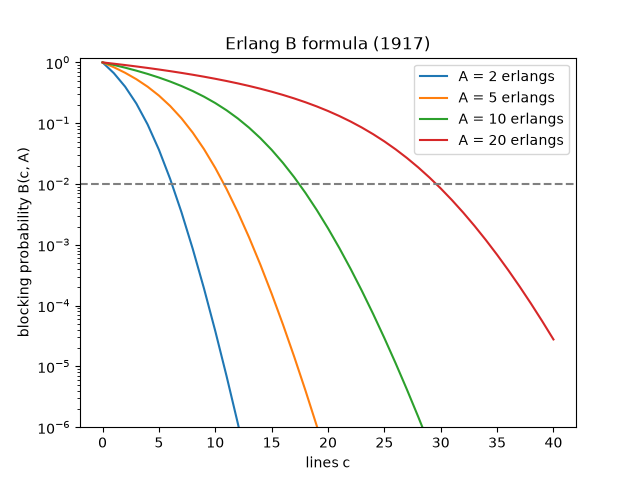
A =    2 erlangs: 7 lines keep blocking below 1%
A =    5 erlangs: 11 lines keep blocking below 1%
A =   10 erlangs: 18 lines keep blocking below 1%
A =   20 erlangs: 30 lines keep blocking below 1%

Text(0.5, 1.0, 'Erlang B formula (1917)')
Total running time of the script: (0 minutes 0.058 seconds)
