Note
Go to the end to download the full example code or to run this example in your browser via JupyterLite.
Gauss’s arithmetic-geometric mean and the elliptic integral K#
Iterates the AGM by hand to show its quadratic convergence, then checks Gauss’s 1799 identity K(m) = pi / (2 AGM(1, sqrt(1 - m))) and uses E(m) for the perimeter of an ellipse.
import math

import matplotlib.pyplot as plt
import numpy as np

from mathematicskit.special_functions import arithmetic_geometric_mean, complete_elliptic_integral_first_kind, complete_elliptic_integral_second_kind
Quadratic convergence: the number of correct digits doubles each step#
step 0: a = 1.0000000000000000, b = 1.4142135623730951, |a - AGM| = 2.0e-01
step 1: a = 1.2071067811865475, b = 1.1892071150027210, |a - AGM| = 9.0e-03
step 2: a = 1.1981569480946344, b = 1.1981235214931201, |a - AGM| = 1.7e-05
step 3: a = 1.1981402347938772, b = 1.1981402346773073, |a - AGM| = 5.8e-11
step 4: a = 1.1981402347355923, b = 1.1981402347355923, |a - AGM| = 2.2e-16
Gauss's constant 1/AGM(1, sqrt 2) = 0.834626841674
K(m) from the AGM#
m = np.linspace(0.0, 0.999, 200)
k_agm = np.pi / (2 * arithmetic_geometric_mean(1.0, np.sqrt(1 - m)))
print(f"\nmax |K(m) - pi/(2 AGM)| = {np.max(np.abs(complete_elliptic_integral_first_kind(m) - k_agm)):.1e}")

fig, ax = plt.subplots()
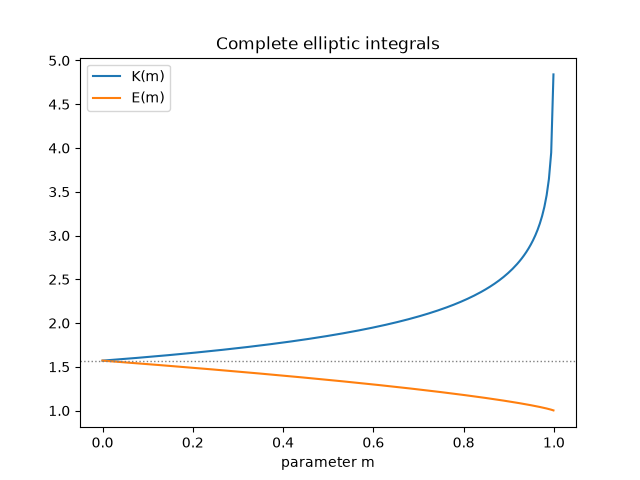
ax.plot(m, complete_elliptic_integral_first_kind(m), label="K(m)")
ax.plot(m, complete_elliptic_integral_second_kind(m), label="E(m)")
ax.axhline(np.pi / 2, color="gray", ls=":", lw=1)
ax.set_xlabel("parameter m")
ax.set_title("Complete elliptic integrals")
ax.legend()
max |K(m) - pi/(2 AGM)| = 8.9e-16

<matplotlib.legend.Legend object at 0x118e2ef90>
The perimeter of an ellipse is 4 a E(e^2)#
semi_major, semi_minor = 2.0, 1.0
ecc2 = 1 - (semi_minor / semi_major) ** 2
perimeter = 4 * semi_major * complete_elliptic_integral_second_kind(ecc2)
t = np.linspace(0, 2 * np.pi, 200001)
polyline = np.sum(np.hypot(np.diff(semi_major * np.cos(t)), np.diff(semi_minor * np.sin(t))))
print(f"\nellipse 2 x 1: 4aE(e^2) = {perimeter:.10f}, polyline length = {polyline:.10f}")
ellipse 2 x 1: 4aE(e^2) = 9.6884482205, polyline length = 9.6884482201
Total running time of the script: (0 minutes 0.028 seconds)
