
Note
Go to the end to download the full example code or to run this example in your browser via JupyterLite.
The two real branches of the Lambert W function#
Plots W_0 and W_{-1}, the two real inverses of w e^w, which meet at the branch point z = -1/e, and uses W to solve x^x = 27.
import math

import matplotlib.pyplot as plt
import numpy as np

from mathematicskit.special_functions import lambert_w
Both real branches#
z0 = np.linspace(-1 / math.e + 1e-9, 6.0, 400)
zm1 = np.linspace(-1 / math.e + 1e-9, -1e-4, 400)

fig, ax = plt.subplots()
ax.plot(z0, lambert_w(z0), label=r"$W_0$ (principal)")
ax.plot(zm1, lambert_w(zm1, branch=-1), label=r"$W_{-1}$")
ax.plot(-1 / math.e, -1, "ko", label=r"branch point $(-1/e, -1)$")
ax.set_ylim(-6, 2)
ax.set_xlabel("z")
ax.set_ylabel("W(z)")
ax.set_title(r"Solutions of $we^w = z$")
ax.legend()
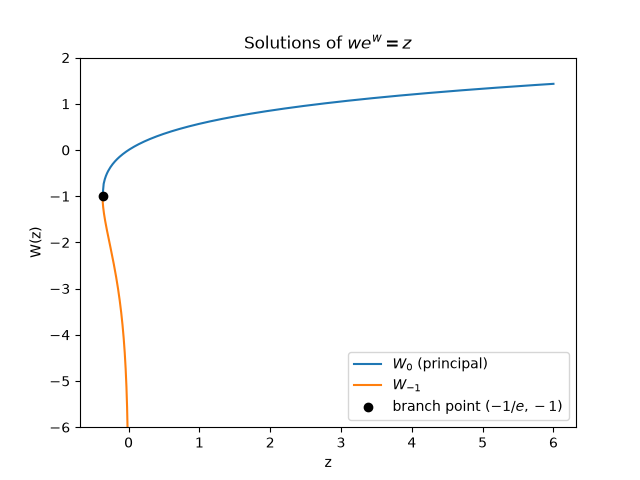
<matplotlib.legend.Legend object at 0x1216a38c0>
The omega constant and a transcendental equation#
Omega = W(1) = 0.567143290410, exp(-Omega) = 0.567143290410
x^x = 27 is solved by x = ln y / W(ln y) = 3.000000000000
Total running time of the script: (0 minutes 0.028 seconds)
