Note
Go to the end to download the full example code or to run this example in your browser via JupyterLite.
Legendre and Chebyshev polynomials on [-1, 1]#
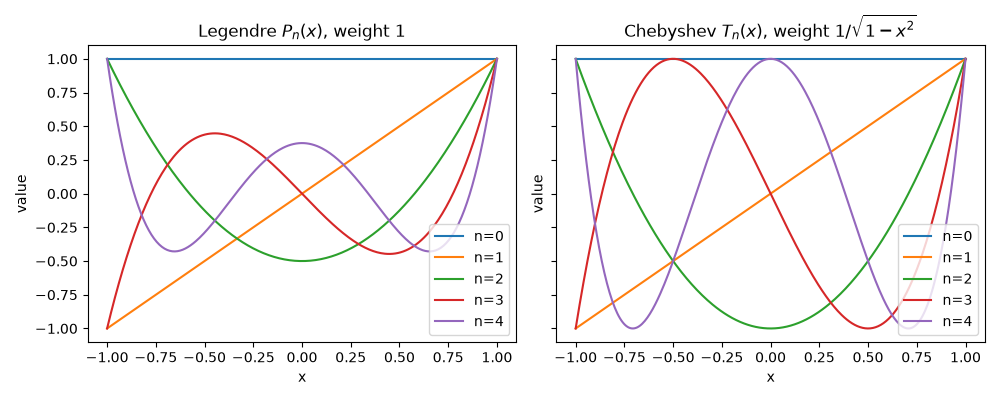
Plots the first Legendre polynomials P_n (weight 1) beside the first Chebyshev polynomials T_n (weight 1/sqrt(1 - x^2)), checks each family’s orthogonality, and confirms Chebyshev’s closed form T_n(cos t) = cos(nt), whose equal ripples between -1 and 1 are its minimal-oscillation property.
import matplotlib.pyplot as plt
import numpy as np

from mathematicskit.special_functions import chebyshev_polynomial, inner_product, legendre_polynomial
from mathematicskit.special_functions.visualizers.plots import plot_polynomial_family
The two families side by side#
fig, (ax_p, ax_t) = plt.subplots(1, 2, figsize=(10, 4), sharey=True)
plot_polynomial_family(legendre_polynomial, degrees=[0, 1, 2, 3, 4], x_range=(-1.0, 1.0), ax=ax_p)
plot_polynomial_family(chebyshev_polynomial, degrees=[0, 1, 2, 3, 4], x_range=(-1.0, 1.0), ax=ax_t)
ax_p.set_title(r"Legendre $P_n(x)$, weight $1$")
ax_t.set_title(r"Chebyshev $T_n(x)$, weight $1/\sqrt{1-x^2}$")
fig.tight_layout()
Orthogonality against each family’s weight#
legendre_ip = inner_product(lambda x: legendre_polynomial(2, x), lambda x: legendre_polynomial(3, x), lambda x: 1.0, -1.0, 1.0)
legendre_norm = inner_product(lambda x: legendre_polynomial(3, x), lambda x: legendre_polynomial(3, x), lambda x: 1.0, -1.0, 1.0)
cheb_weight = lambda x: 1.0 / np.sqrt(1.0 - x**2)  # noqa: E731
chebyshev_ip = inner_product(lambda x: chebyshev_polynomial(2, x), lambda x: chebyshev_polynomial(4, x), cheb_weight, -1.0, 1.0)
chebyshev_norm = inner_product(lambda x: chebyshev_polynomial(4, x), lambda x: chebyshev_polynomial(4, x), cheb_weight, -1.0, 1.0)

print(f"<P_2, P_3> = {legendre_ip:.2e}, <P_3, P_3> = {legendre_norm:.6f} (2/7 = {2 / 7:.6f})")
print(f"<T_2, T_4> = {chebyshev_ip:.2e}, <T_4, T_4> = {chebyshev_norm:.6f} (pi/2 = {np.pi / 2:.6f})")
<P_2, P_3> = 0.00e+00, <P_3, P_3> = 0.285714 (2/7 = 0.285714)
<T_2, T_4> = -2.13e-12, <T_4, T_4> = 1.570796 (pi/2 = 1.570796)
Chebyshev’s closed form T_n(cos t) = cos(n t)#
n = 3: max |T_n(cos t) - cos(nt)| = 1.2e-15
n = 5: max |T_n(cos t) - cos(nt)| = 2.2e-15
n = 8: max |T_n(cos t) - cos(nt)| = 4.3e-15
Total running time of the script: (0 minutes 0.084 seconds)
