
Note
Go to the end to download the full example code or to run this example in your browser via JupyterLite.
Daubechies wavelets: vanishing moments and compression#
Daubechies’ 1988 compactly supported orthonormal wavelets have p vanishing moments with a filter of only 2p taps, so polynomial pieces of degree below p produce near-zero detail coefficients. Keeping only the largest coefficients then compresses a smooth signal far better than Haar (p = 1) can.
import matplotlib.pyplot as plt
import numpy as np

from mathematicskit.special_functions import WaveletDecompositionResult, daubechies_filter, discrete_wavelet_transform, inverse_discrete_wavelet_transform
The db2 filter in closed form#
db2 by spectral factorization: [ 0.48296291  0.8365163   0.22414387 -0.12940952]
(1+-sqrt3, 3+-sqrt3)/(4 sqrt2): [ 0.48296291  0.8365163   0.22414387 -0.12940952]
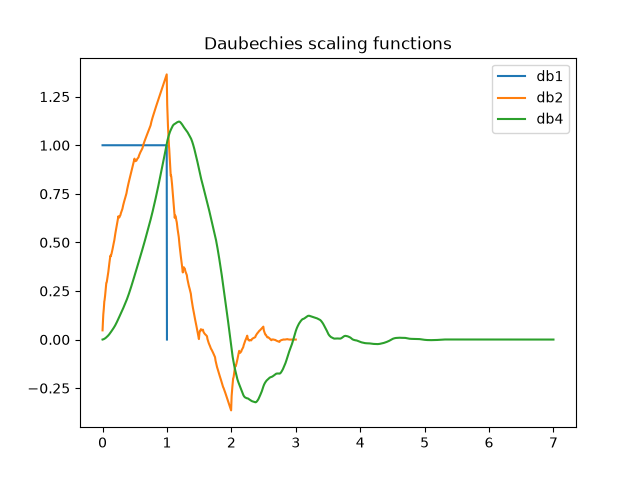
The scaling function by the cascade algorithm#
Iterating phi(x) = sqrt2 sum h[k] phi(2x - k) from a single spike (inverse DWT of one approximation coefficient) converges to phi.
fig, ax = plt.subplots()
for p in (1, 2, 4):
    level = 8
    approx = np.zeros(2 * p * 2)
    approx[0] = 1.0
    details = [np.zeros(approx.size * 2**j) for j in range(level)][::-1]
    phi = inverse_discrete_wavelet_transform(WaveletDecompositionResult(approx, details, f"db{p}"))
    support = 2 * p - 1
    xs = np.arange(phi.size) / 2**level
    mask = xs <= support
    ax.plot(xs[mask], phi[mask] * 2 ** (level / 2), label=f"db{p}")
ax.set_title("Daubechies scaling functions")
ax.legend()
<matplotlib.legend.Legend object at 0x118e2fcb0>
Keep the largest 5% of coefficients#
n = 1024
t = np.linspace(0.0, 1.0, n, endpoint=False)
x = np.sin(4 * np.pi * t) * np.exp(-2 * t) + 0.5 * t**2
keep = int(0.05 * n)

fig, ax = plt.subplots()
ax.plot(t, x, lw=3, alpha=0.3, color="k", label="signal")
for wavelet in ("haar", "db2", "db4"):
    result = discrete_wavelet_transform(x, wavelet, level=6)
    threshold = np.sort(np.abs(np.concatenate([result.approximation, *result.details])))[-keep]
    result.details = [np.where(np.abs(d) >= threshold, d, 0.0) for d in result.details]
    y = inverse_discrete_wavelet_transform(result)
    error = np.linalg.norm(y - x) / np.linalg.norm(x)
    print(f"{wavelet:>4}: relative error keeping {keep} of {n} coefficients = {error:.2e}")
    ax.plot(t, y, label=f"{wavelet} ({error:.1e})")
ax.set_title("5% of the wavelet coefficients")
ax.legend()
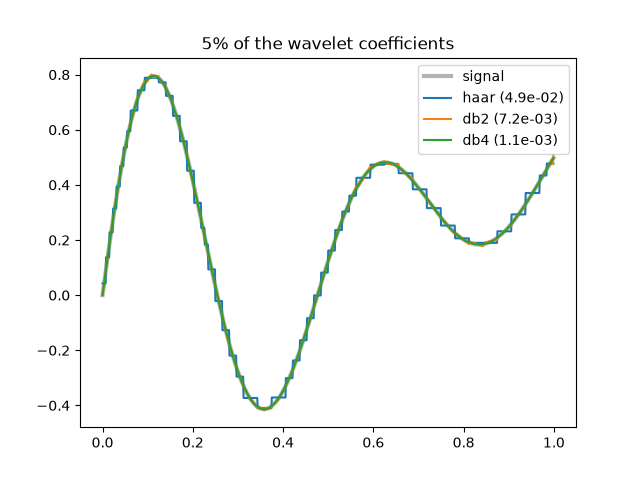
haar: relative error keeping 51 of 1024 coefficients = 4.91e-02
 db2: relative error keeping 51 of 1024 coefficients = 7.17e-03
 db4: relative error keeping 51 of 1024 coefficients = 1.11e-03

<matplotlib.legend.Legend object at 0x121891550>
Total running time of the script: (0 minutes 0.057 seconds)
