
Note
Go to the end to download the full example code or to run this example in your browser via JupyterLite.
The Riemann zeta function and Euler’s product#
Plots zeta(s) on the real line, including its analytic continuation to s < 1 with trivial zeros at the negative even integers, and shows Euler’s product over primes converging to zeta(2) = pi^2/6.
import math

import matplotlib.pyplot as plt
import numpy as np

from mathematicskit.special_functions import euler_product, riemann_zeta
zeta on the real line#
s = np.concatenate([np.linspace(-9, 0.95, 500), np.linspace(1.05, 6, 200)])
values = riemann_zeta(s)
fig, ax = plt.subplots()
ax.plot(s[s < 1], values[s < 1], "C0")
ax.plot(s[s > 1], values[s > 1], "C0")
ax.plot([-2, -4, -6, -8], [0, 0, 0, 0], "ro", label="trivial zeros")
ax.axhline(0, color="gray", lw=0.5)
ax.set_ylim(-2, 4)
ax.set_xlabel("s")
ax.set_ylabel(r"$\zeta(s)$")
ax.legend()
print(f"zeta(2) = {riemann_zeta(2.0):.12f}, pi^2/6 = {math.pi**2 / 6:.12f}")
print(f"zeta(0) = {riemann_zeta(0.0):.6f}, zeta(-1) = {riemann_zeta(-1.0):.6f} (= -1/12)")
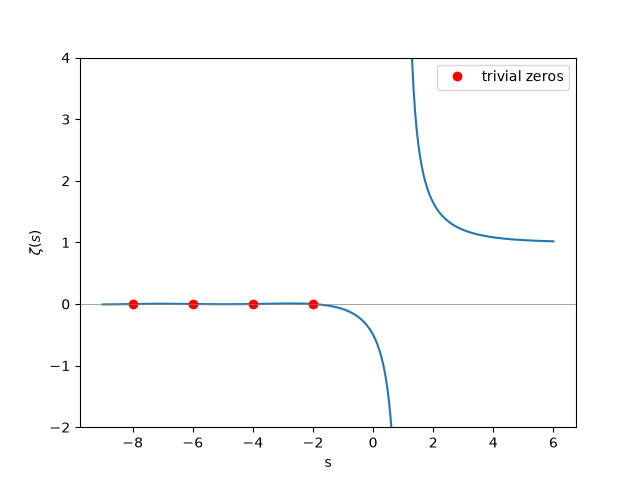
zeta(2) = 1.644934066848, pi^2/6 = 1.644934066848
zeta(0) = -0.500000, zeta(-1) = -0.083333 (= -1/12)
Euler’s product over primes#
primes <=    10: product = 1.59505208, error = 5.0e-02
primes <=   100: product = 1.64194520, error = 3.0e-03
primes <=  1000: product = 1.64472519, error = 2.1e-04
primes <= 10000: product = 1.64491792, error = 1.6e-05
Total running time of the script: (0 minutes 0.020 seconds)
