Note
Go to the end to download the full example code or to run this example in your browser via JupyterLite.
Stirling’s numbers: cycles, set partitions, and Bell numbers#
Checks by brute force that Stirling numbers of the first kind count permutations by their number of cycles and that Stirling numbers of the second kind count partitions of a labeled set into k blocks. It then recovers Stirling’s own use of them, converting ordinary powers into falling factorials, and sums the second kind to get the Bell numbers.
from itertools import permutations, product
from math import factorial, perm

import matplotlib.pyplot as plt
import numpy as np

from mathematicskit.combinatorics import bell_number, stirling_first_kind, stirling_second_kind


def _cycle_count(p):
    seen, cycles = set(), 0
    for start in range(len(p)):
        if start not in seen:
            cycles += 1
            i = start
            while i not in seen:
                seen.add(i)
                i = p[i]
    return cycles


def _block_count(labels):
    # A restricted-growth string (label i is at most 1 + max of earlier labels)
    # encodes each set partition exactly once.
    if labels[0] != 0 or any(b > max(labels[:i]) + 1 for i, b in enumerate(labels) if i):
        return None
    return max(labels) + 1
First kind: permutations of 5 elements by number of cycles#
enumerated : [0, 24, 50, 35, 10, 1]
[5 k]      : [0, 24, 50, 35, 10, 1]
sum = 120 = 5!
Second kind: partitions of {1,…,5} into k blocks#
by_blocks = [0] * (n + 1)
for labels in product(range(n), repeat=n):
    k = _block_count(labels)
    if k is not None:
        by_blocks[k] += 1
print("enumerated :", by_blocks)
print("{5 k}      :", [stirling_second_kind(n, k) for k in range(n + 1)])
print(f"Bell number B_5 = {bell_number(n)} = {sum(by_blocks)} set partitions")
enumerated : [0, 1, 15, 25, 10, 1]
{5 k}      : [0, 1, 15, 25, 10, 1]
Bell number B_5 = 52 = 52 set partitions
Stirling’s conversion between powers and falling factorials#
x = 7
for m in range(1, 6):
    via_second = sum(stirling_second_kind(m, k) * perm(x, k) for k in range(m + 1))
    via_first = sum(stirling_first_kind(m, k, signed=True) * x**k for k in range(m + 1))
    print(f"m={m}: x^m = {x**m} = sum S2*x_(k) = {via_second};  x_(m) = {perm(x, m)} = sum s1*x^k = {via_first}")
    assert via_second == x**m and via_first == perm(x, m)
m=1: x^m = 7 = sum S2*x_(k) = 7;  x_(m) = 7 = sum s1*x^k = 7
m=2: x^m = 49 = sum S2*x_(k) = 49;  x_(m) = 42 = sum s1*x^k = 42
m=3: x^m = 343 = sum S2*x_(k) = 343;  x_(m) = 210 = sum s1*x^k = 210
m=4: x^m = 2401 = sum S2*x_(k) = 2401;  x_(m) = 840 = sum s1*x^k = 840
m=5: x^m = 16807 = sum S2*x_(k) = 16807;  x_(m) = 2520 = sum s1*x^k = 2520
The two triangles side by side#
N = 8
first = np.array([[stirling_first_kind(i, k) for k in range(N + 1)] for i in range(N + 1)], dtype=float)
second = np.array([[stirling_second_kind(i, k) for k in range(N + 1)] for i in range(N + 1)], dtype=float)
fig, axes = plt.subplots(1, 2, figsize=(10, 4.5))
for ax, table, name in zip(axes, [first, second], ["first kind (cycles)", "second kind (blocks)"], strict=False):
    shown = np.where(table > 0, np.log10(np.maximum(table, 1)), np.nan)
    ax.imshow(shown, cmap="viridis")
    for i in range(N + 1):
        for k in range(i + 1):
            if table[i, k] > 0:
                dark = shown[i, k] > 0.6 * np.nanmax(shown)
                ax.text(k, i, f"{int(table[i, k])}", ha="center", va="center", fontsize=6, color="black" if dark else "white")
    ax.set_xlabel("k")
    ax.set_ylabel("n")
    ax.set_title(f"Stirling numbers of the {name}")
fig.tight_layout()
print(f"\nrow sums: first kind -> n! = {factorial(N)}, second kind -> Bell B_{N} = {bell_number(N)}")
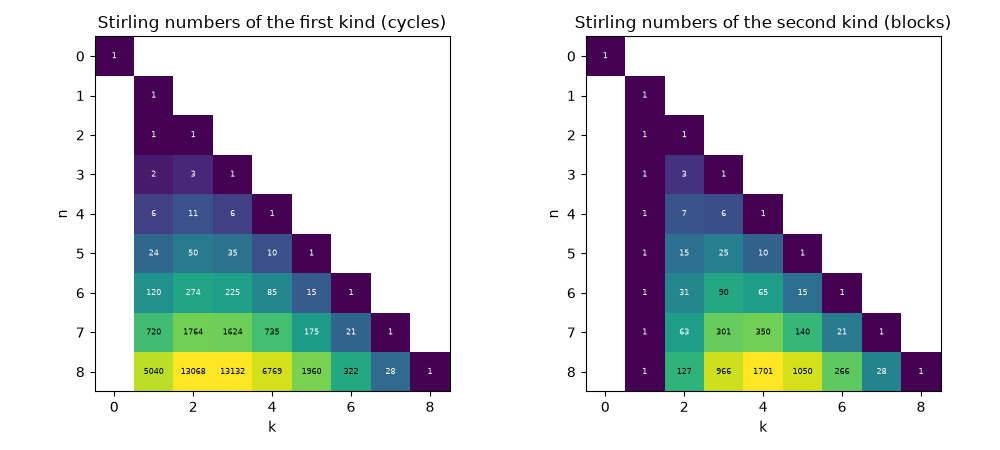
row sums: first kind -> n! = 40320, second kind -> Bell B_8 = 4140
Total running time of the script: (0 minutes 0.095 seconds)
