
Note
Go to the end to download the full example code or to run this example in your browser via JupyterLite.
Catalan numbers: Euler’s polygon triangulations and Catalan’s brackets#
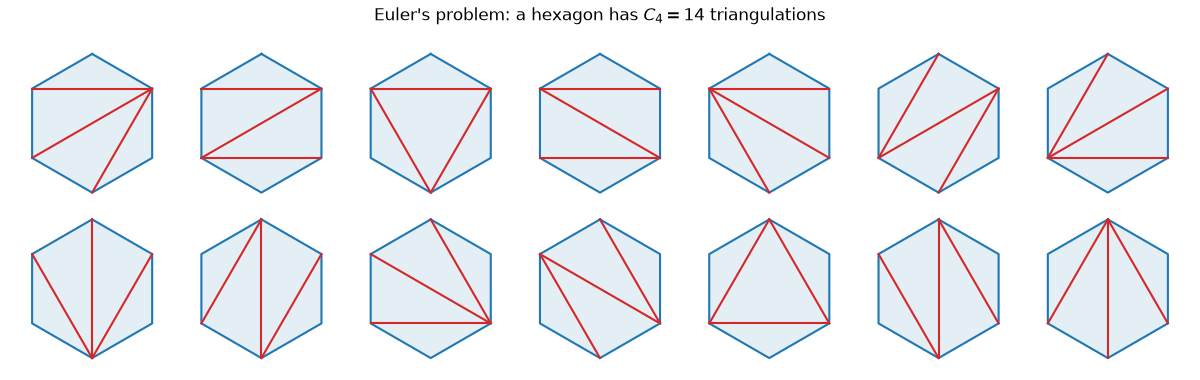
Draws all 14 triangulations of a convex hexagon, the problem Euler posed to Goldbach in 1751, and checks that the same Catalan numbers count balanced parenthesizations, Catalan’s bracketing problem of 1838.
import itertools

import matplotlib.pyplot as plt
import numpy as np

from mathematicskit.combinatorics import catalan_number, combinations_count


def _triangulations(vertices):
    """All triangulations of the convex polygon ``vertices``, as lists of diagonals."""
    if len(vertices) < 3:
        return [[]]
    a, b = vertices[0], vertices[-1]
    result = []
    # The edge a-b lies in exactly one triangle (a, c, b); recurse on both sides.
    for i in range(1, len(vertices) - 1):
        c = vertices[i]
        chords = [(a, c)] if i > 1 else []
        chords += [(c, b)] if i < len(vertices) - 2 else []
        for left in _triangulations(vertices[: i + 1]):
            for right in _triangulations(vertices[i:]):
                result.append(chords + left + right)
    return result


def _is_balanced(s):
    depth = 0
    for ch in s:
        depth += 1 if ch == "(" else -1
        if depth < 0:
            return False
    return depth == 0
Euler’s problem: triangulations of a convex (n+2)-gon#
3-gon:    1 triangulations, C_1 = 1
4-gon:    2 triangulations, C_2 = 2
5-gon:    5 triangulations, C_3 = 5
6-gon:   14 triangulations, C_4 = 14
7-gon:   42 triangulations, C_5 = 42
8-gon:  132 triangulations, C_6 = 132
9-gon:  429 triangulations, C_7 = 429
Catalan’s problem: balanced parenthesizations#
for n in range(1, 7):
    balanced = sum(_is_balanced(s) for s in itertools.product("()", repeat=2 * n))
    closed_form = combinations_count(2 * n, n) // (n + 1)
    print(f"n={n}: {balanced:3d} balanced strings, C_{n} = {catalan_number(n)}, binom(2n,n)/(n+1) = {closed_form}")
print("n=3:", ["".join(s) for s in itertools.product("()", repeat=6) if _is_balanced(s)])
n=1:   1 balanced strings, C_1 = 1, binom(2n,n)/(n+1) = 1
n=2:   2 balanced strings, C_2 = 2, binom(2n,n)/(n+1) = 2
n=3:   5 balanced strings, C_3 = 5, binom(2n,n)/(n+1) = 5
n=4:  14 balanced strings, C_4 = 14, binom(2n,n)/(n+1) = 14
n=5:  42 balanced strings, C_5 = 42, binom(2n,n)/(n+1) = 42
n=6: 132 balanced strings, C_6 = 132, binom(2n,n)/(n+1) = 132
n=3: ['((()))', '(()())', '(())()', '()(())', '()()()']
The 14 triangulations of a hexagon#
angles = np.pi / 2 + 2 * np.pi * np.arange(6) / 6
pts = np.column_stack([np.cos(angles), np.sin(angles)])
fig, axes = plt.subplots(2, 7, figsize=(12, 3.8))
for ax, diagonals in zip(axes.flat, _triangulations(list(range(6))), strict=False):
    ax.fill(pts[:, 0], pts[:, 1], color="C0", alpha=0.12)
    ax.plot(*np.vstack([pts, pts[:1]]).T, color="C0", lw=1.5)
    for i, j in diagonals:
        ax.plot(*pts[[i, j]].T, color="C3", lw=1.5)
    ax.set_aspect("equal")
    ax.axis("off")
fig.suptitle(f"Euler's problem: a hexagon has $C_4 = {catalan_number(4)}$ triangulations")
fig.tight_layout()
Total running time of the script: (0 minutes 0.052 seconds)
