
Note
Go to the end to download the full example code or to run this example in your browser via JupyterLite.
Pick’s theorem: area from lattice points#
Counts the lattice points inside and on the boundary of polygons with integer vertices, and checks Pick’s formula A = I + B/2 - 1 against the shoelace area.
import matplotlib.pyplot as plt
import numpy as np

from mathematicskit.geometry import lattice_point_counts, point_in_polygon
Several lattice polygons#
polygons = {
    "rectangle": [[0, 0], [4, 0], [4, 3], [0, 3]],
    "triangle": [[0, 0], [7, 2], [3, 6]],
    "non-convex": [[0, 0], [6, 0], [6, 5], [3, 2], [0, 5]],
}
for name, vertices in polygons.items():
    r = lattice_point_counts(vertices)
    print(f"{name:10s}: I = {r.interior:2d}, B = {r.boundary:2d}, I + B/2 - 1 = {r.pick_area:5.1f}, shoelace area = {r.area:5.1f}")
rectangle : I =  6, B = 14, I + B/2 - 1 =  12.0, shoelace area =  12.0
triangle  : I = 15, B =  8, I + B/2 - 1 =  18.0, shoelace area =  18.0
non-convex: I = 11, B = 22, I + B/2 - 1 =  21.0, shoelace area =  21.0
Picture of the non-convex case#
v = np.array(polygons["non-convex"], dtype=float)
fig, ax = plt.subplots()
ax.fill(*v.T, alpha=0.3)
for x in range(0, 7):
    for y in range(0, 6):
        inside = point_in_polygon(np.array([x, y], dtype=float), v)
        ax.plot(x, y, "o", color="tab:green" if inside else "0.8", ms=5)
ax.set_aspect("equal")
ax.set_title("Pick: area = interior points + boundary points / 2 - 1")
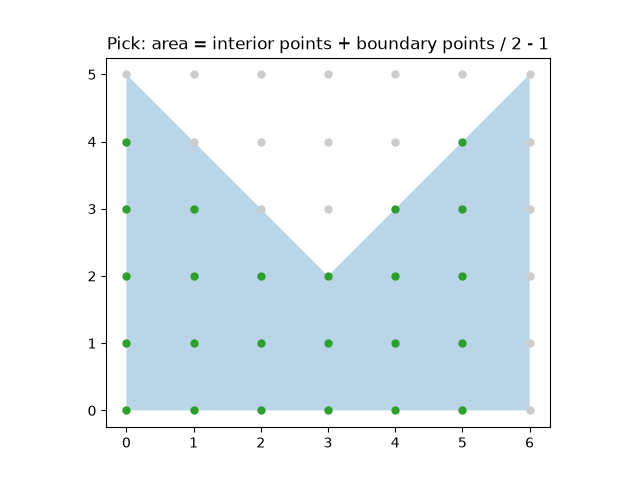
Text(0.5, 1.0, 'Pick: area = interior points + boundary points / 2 - 1')
Total running time of the script: (0 minutes 0.026 seconds)
