Note
Go to the end to download the full example code or to run this example in your browser via JupyterLite.
Heron’s formula and needle-like triangles#
Checks Heron’s formula against the shoelace formula, then shows why the arrangement matters: for a thin “needle” triangle the textbook form sqrt(s(s-a)(s-b)(s-c)) loses most of its digits, while Kahan’s rearrangement stays accurate.
import matplotlib.pyplot as plt
import numpy as np

from mathematicskit.geometry import heron_area, polygon_area
Agreement with the shoelace formula#
sides 4.0000, 4.2426, 3.1623: Heron 6.000000000000, shoelace 6.000000000000
Needle triangles: textbook form vs. Kahan’s arrangement#
def textbook(a, b, c):
    s = (a + b + c) / 2
    return np.sqrt(max(s * (s - a) * (s - b) * (s - c), 0.0))


widths = np.logspace(-1, -12, 40)
exact = [w / 2 * np.sqrt(1 - w * w / 4) for w in widths]  # isosceles, legs of length 1, base w
naive_err = [abs(textbook(1.0, 1.0, w) - e) / e for w, e in zip(widths, exact, strict=False)]
kahan_err = [max(abs(heron_area(1.0, 1.0, w) - e) / e, 1e-17) for w, e in zip(widths, exact, strict=False)]

fig, ax = plt.subplots()
ax.loglog(widths, naive_err, "o-", ms=3, label="textbook Heron")
ax.loglog(widths, kahan_err, "s-", ms=3, label="Kahan's arrangement")
ax.invert_xaxis()
ax.set_xlabel("base of isosceles triangle with unit legs")
ax.set_ylabel("relative error in area")
ax.legend()
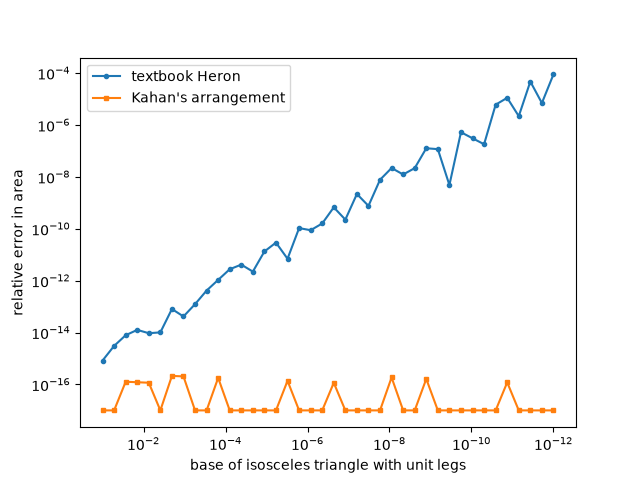
<matplotlib.legend.Legend object at 0x1134d5400>
Total running time of the script: (0 minutes 0.036 seconds)
