Note
Go to the end to download the full example code or to run this example in your browser via JupyterLite.
Delaunay triangulation: empty circumcircles and fat triangles#
Triangulates a random point set with
delaunay_triangulation(), checks
Delaunay’s defining property (no point lies inside any triangle’s
circumcircle), and shows on four points that choosing the Delaunay
diagonal maximizes the smallest angle and avoids needle-like
triangles.
import matplotlib.pyplot as plt
import numpy as np

from mathematicskit.geometry import delaunay_triangulation, polygon_area
from mathematicskit.geometry.visualizers.plots import plot_triangulation


def circumcircle(a, b, c):
    """Center and radius of the circle through three points."""
    d = 2 * (a[0] * (b[1] - c[1]) + b[0] * (c[1] - a[1]) + c[0] * (a[1] - b[1]))
    sq = [p @ p for p in (a, b, c)]
    ux = (sq[0] * (b[1] - c[1]) + sq[1] * (c[1] - a[1]) + sq[2] * (a[1] - b[1])) / d
    uy = (sq[0] * (c[0] - b[0]) + sq[1] * (a[0] - c[0]) + sq[2] * (b[0] - a[0])) / d
    center = np.array([ux, uy])
    return center, np.linalg.norm(a - center)


def min_angle(points, simplices):
    """Smallest interior angle (degrees) over all triangles."""
    worst = 180.0
    for tri in simplices:
        p = points[tri]
        for k in range(3):
            u, v = p[(k + 1) % 3] - p[k], p[(k + 2) % 3] - p[k]
            cos = u @ v / (np.linalg.norm(u) * np.linalg.norm(v))
            worst = min(worst, np.degrees(np.arccos(np.clip(cos, -1, 1))))
    return worst
The empty-circle property#
rng = np.random.default_rng(0)
points = rng.uniform(0, 10, size=(15, 2))
result = delaunay_triangulation(points)

violations = 0
for tri in result.simplices:
    center, radius = circumcircle(*points[tri])
    others = np.delete(points, tri, axis=0)
    violations += int(np.sum(np.linalg.norm(others - center, axis=1) < radius - 1e-9))
print(f"{result.simplices.shape[0]} triangles; points strictly inside a circumcircle: {violations}")
22 triangles; points strictly inside a circumcircle: 0
Delaunay maximizes the smallest angle#
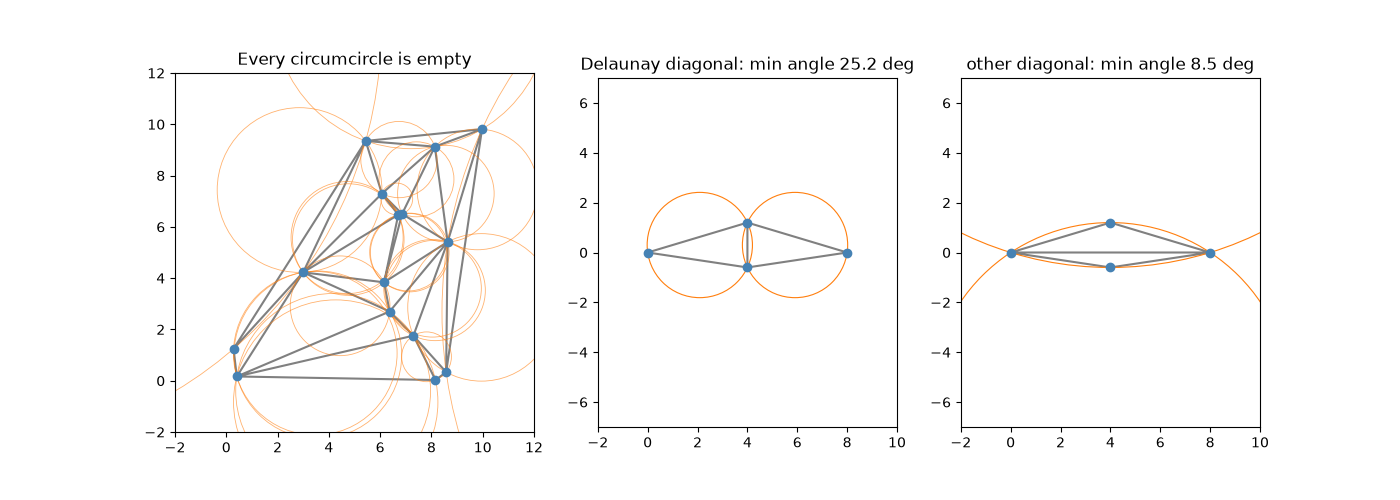
Four points can be triangulated in two ways, by either diagonal. The Delaunay choice avoids the thin pair of triangles and keeps the other diagonal’s endpoints out of each circumcircle.
quad = np.array([[0.0, 0.0], [4.0, -0.6], [8.0, 0.0], [4.0, 1.2]])
delaunay_quad = delaunay_triangulation(quad).simplices
diagonal = set(delaunay_quad[0]) & set(delaunay_quad[1])
print(f"Delaunay uses diagonal {sorted(int(i) for i in diagonal)}")
# the other triangulation uses the opposite diagonal
other_quad = np.array([[0, 1, 2], [0, 2, 3]]) if diagonal == {1, 3} else np.array([[0, 1, 3], [1, 2, 3]])
print(f"smallest angle: Delaunay {min_angle(quad, delaunay_quad):.2f} deg, other diagonal {min_angle(quad, other_quad):.2f} deg")
print(f"both cover the same area: {polygon_area(quad):.4f}")
Delaunay uses diagonal [1, 3]
smallest angle: Delaunay 25.23 deg, other diagonal 8.53 deg
both cover the same area: 7.2000
The triangulation and its empty circumcircles#
fig, axes = plt.subplots(1, 3, figsize=(14, 5), gridspec_kw={"width_ratios": [1.2, 1, 1]})
plot_triangulation(result, ax=axes[0])
for tri in result.simplices:
    center, radius = circumcircle(*points[tri])
    axes[0].add_patch(plt.Circle(center, radius, fill=False, color="tab:orange", lw=0.6, alpha=0.6))
axes[0].set_xlim(-2, 12)
axes[0].set_ylim(-2, 12)
axes[0].set_title("Every circumcircle is empty")
for ax, simplices, label in [(axes[1], delaunay_quad, "Delaunay diagonal"), (axes[2], other_quad, "other diagonal")]:
    ax.triplot(quad[:, 0], quad[:, 1], simplices, color="gray")
    ax.scatter(quad[:, 0], quad[:, 1], color="steelblue", zorder=2)
    for tri in simplices:
        center, radius = circumcircle(*quad[tri])
        ax.add_patch(plt.Circle(center, radius, fill=False, color="tab:orange", lw=0.8))
    ax.set_xlim(-2, 10)
    ax.set_ylim(-7, 7)
    ax.set_aspect("equal")
    ax.set_title(f"{label}: min angle {min_angle(quad, simplices):.1f} deg")
plt.show()
Total running time of the script: (0 minutes 0.067 seconds)
