
Note
Go to the end to download the full example code or to run this example in your browser via JupyterLite.
The Kullback-Leibler divergence (1951)#
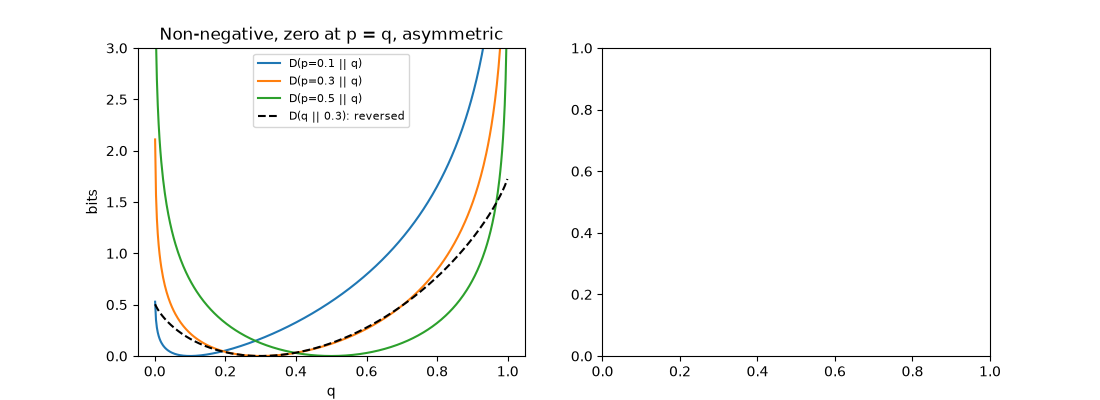
Kullback and Leibler defined \(D(p\,\|\,q) = \sum p\log(p/q)\) as the mean information per observation for telling \(p\) from \(q\). It is never negative (Gibbs’ inequality) and vanishes only at \(p = q\), but it is not symmetric. It is also the extra bits per symbol paid for coding a \(p\)-source with a code built for \(q\).
import matplotlib.pyplot as plt
import numpy as np

from mathematicskit.information_theory import entropy, huffman_code, kl_divergence

q = np.linspace(0.001, 0.999, 400)
fig, (ax1, ax2) = plt.subplots(1, 2, figsize=(11, 4))
for p in (0.1, 0.3, 0.5):
    ax1.plot(q, [kl_divergence([p, 1 - p], [qi, 1 - qi]) for qi in q], label=f"D(p={p} || q)")
ax1.plot(q, [kl_divergence([qi, 1 - qi], [0.3, 0.7]) for qi in q], "k--", label="D(q || 0.3): reversed")
ax1.set_ylim(0, 3)
ax1.set_xlabel("q")
ax1.set_ylabel("bits")
ax1.set_title("Non-negative, zero at p = q, asymmetric")
ax1.legend(fontsize=8)
<matplotlib.legend.Legend object at 0x113533770>
The cost of a wrong model#
Code a source \(p\) with ideal lengths \(-\log_2 q\): the average length is \(H(p) + D(p\,\|\,q)\).
rng = np.random.default_rng(0)
p = rng.dirichlet(np.ones(8))
models = [rng.dirichlet(np.ones(8)) for _ in range(40)]
excess = [-(p @ np.log2(m)) - entropy(p) for m in models]
divergence = [kl_divergence(p, m) for m in models]
ax2.plot(divergence, excess, "o")
ax2.plot([0, max(divergence)], [0, max(divergence)], "k--", lw=1)
ax2.set_xlabel("D(p || q)")
ax2.set_ylabel("excess bits per symbol")
ax2.set_title("Mismatched code costs exactly D(p || q)")
print(f"Huffman code for p itself: {huffman_code(p).average_length - entropy(p):.3f} excess bits")
Huffman code for p itself: 0.107 excess bits
Total running time of the script: (0 minutes 0.167 seconds)
