
Note
Go to the end to download the full example code or to run this example in your browser via JupyterLite.
Pell’s equation x^2 - Dy^2 = 1#
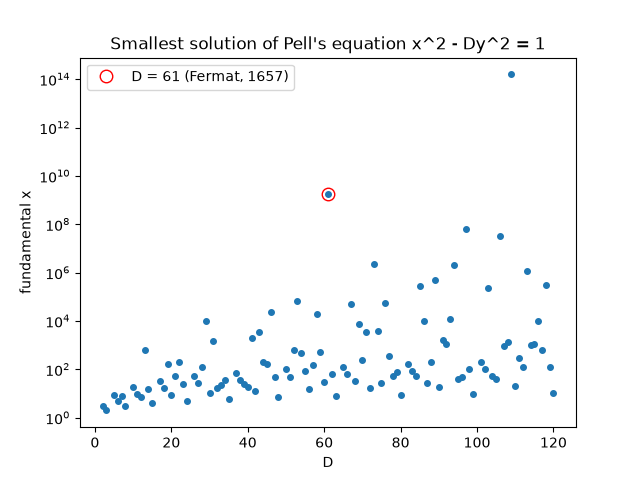
Fermat’s 1657 challenge: solve \(x^2 - Dy^2 = 1\) in integers. The continued fraction of \(\sqrt D\) always yields the fundamental solution (Lagrange, 1768), but its size is wildly erratic – for \(D = 61\) it is \(x = 1766319049\), while \(D = 60\) needs only \(x = 31\). This script reproduces Fermat’s \(D = 61\) case, generates further solutions from the fundamental one, and plots the fundamental \(x\) for every non-square \(D \le 120\).
import math

import matplotlib.pyplot as plt

from mathematicskit.number_theory import solve_pell_equation
Fermat’s challenge: D = 61#
fundamental solution of x^2 - 61y^2 = 1: x=1766319049, y=226153980
check: x^2 - 61y^2 = 1
Every solution is a power of the fundamental one#
\(x_k + y_k\sqrt D = (x_1 + y_1\sqrt D)^k\).
k=2: x has 19 digits, x^2 - 61y^2 = 1
k=3: x has 29 digits, x^2 - 61y^2 = 1
The fundamental solution’s size jumps around with D#
ds = [d for d in range(2, 121) if math.isqrt(d) ** 2 != d]
xs = [solve_pell_equation(d).x for d in ds]

fig, ax = plt.subplots()
ax.semilogy(ds, xs, "o", ms=4)
ax.semilogy([61], [pell.x], "o", ms=9, mfc="none", mec="red", label="D = 61 (Fermat, 1657)")
ax.set_xlabel("D")
ax.set_ylabel("fundamental x")
ax.set_title("Smallest solution of Pell's equation x^2 - Dy^2 = 1")
ax.legend()
plt.show()
Total running time of the script: (0 minutes 0.035 seconds)
