Note
Go to the end to download the full example code or to run this example in your browser via JupyterLite.
Dirichlet’s theorem and prime races#
Dirichlet proved in 1837 that every progression \(a, a+q, a+2q, \dots\) with \(\gcd(a, q) = 1\) contains infinitely many primes, and the classes share the primes equally in the limit. Equal in the limit is not equal at every point: the race between primes \(\equiv 3\) and \(\equiv 1 \pmod 4\) is led by the 3s almost all the time (“Chebyshev’s bias”, 1853).
import math

import matplotlib.pyplot as plt
import numpy as np

from mathematicskit.number_theory import primes_in_progression
The mod-4 prime race#
ones = primes_in_progression(1, 4, limit)
threes = primes_in_progression(3, 4, limit)
xs = np.arange(1, limit + 1, 97)
lead = np.searchsorted(threes, xs, side="right") - np.searchsorted(ones, xs, side="right")
ones_lead = np.searchsorted(ones, ones, side="right") > np.searchsorted(threes, ones, side="right")
print(f"first x where the 1s take the lead: {ones[np.argmax(ones_lead)]} (Leech, 1957)")
print(f"fraction of sampled x <= {limit} with the 3s ahead or tied: {np.mean(lead >= 0):.4f}")

fig, ax = plt.subplots()
ax.plot(xs, lead, lw=0.8)
ax.axhline(0, color="0.5", ls=":")
ax.set_xlabel("x")
ax.set_ylabel("pi(x; 4, 3) - pi(x; 4, 1)")
ax.set_title("Chebyshev's bias: primes 3 mod 4 lead")
plt.show()
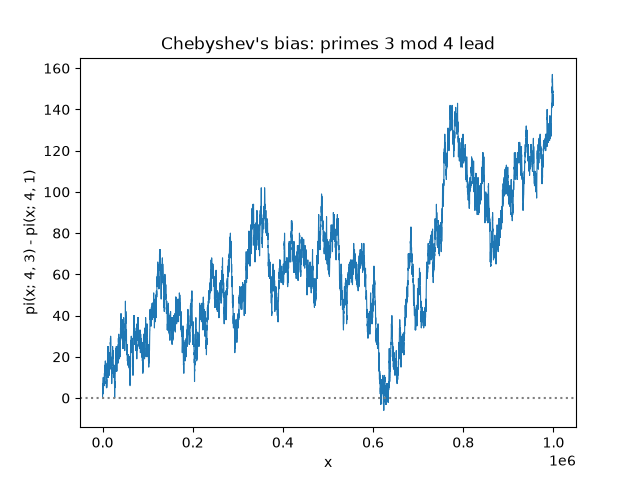
first x where the 1s take the lead: 26861 (Leech, 1957)
fraction of sampled x <= 1000000 with the 3s ahead or tied: 0.9962
Total running time of the script: (0 minutes 0.053 seconds)
