Note
Go to the end to download the full example code or to run this example in your browser via JupyterLite.
Runge’s phenomenon: equally spaced interpolation diverges#
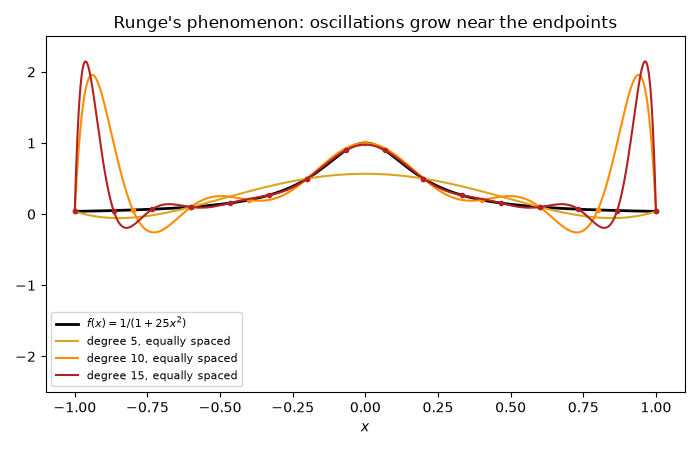
Carl Runge’s 1901 example \(f(x) = 1/(1+25x^2)\) is smooth on \([-1, 1]\), yet interpolating it at more equally spaced nodes makes the fit worse: oscillations near the endpoints grow without bound as the degree increases. This script shows the overshoot for growing degree, the maximum error blowing up, and the exponentially growing Lebesgue constant of equally spaced nodes that causes it.
import matplotlib.pyplot as plt
import numpy as np

from mathematicskit.numerical_analysis import LagrangeInterpolant, runge_function
from mathematicskit.numerical_analysis.systems.chebyshev import runge_phenomenon_errors
from mathematicskit.numerical_analysis.utils.error_analysis import lebesgue_constant
More equally spaced nodes, bigger wiggles#
x_fine = np.linspace(-1.0, 1.0, 600)
fig1, ax1 = plt.subplots(figsize=(7, 4.5))
ax1.plot(x_fine, runge_function(x_fine), color="black", lw=2, label=r"$f(x) = 1/(1+25x^2)$")
for n, color in ((6, "goldenrod"), (11, "darkorange"), (16, "firebrick")):
    nodes = np.linspace(-1.0, 1.0, n)
    p = LagrangeInterpolant(nodes, runge_function(nodes))
    ax1.plot(x_fine, p.evaluate(x_fine), color=color, label=f"degree {n - 1}, equally spaced")
    ax1.plot(nodes, runge_function(nodes), "o", ms=3, color=color)
ax1.set_ylim(-2.5, 2.5)
ax1.set_xlabel("$x$")
ax1.set_title("Runge's phenomenon: oscillations grow near the endpoints")
ax1.legend(fontsize=8)
fig1.tight_layout()
The maximum error diverges with degree#
degrees = [5, 10, 15, 20, 25, 30]
equal_errors, _ = runge_phenomenon_errors(degrees)
for d, e in zip(degrees, equal_errors, strict=False):
    print(f"degree={d:2d}  equally spaced max |error| = {e:.3e}")

fig2, ax2 = plt.subplots(figsize=(6, 4))
ax2.semilogy(degrees, equal_errors, "o-", color="firebrick")
ax2.set_xlabel("polynomial degree")
ax2.set_ylabel(r"$\max |f - p_n|$")
ax2.set_title("Equally spaced interpolation error grows without bound")
fig2.tight_layout()
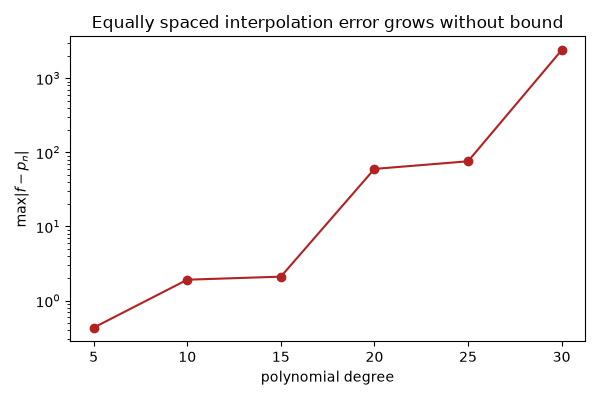
degree= 5  equally spaced max |error| = 4.327e-01
degree=10  equally spaced max |error| = 1.916e+00
degree=15  equally spaced max |error| = 2.107e+00
degree=20  equally spaced max |error| = 5.977e+01
degree=25  equally spaced max |error| = 7.576e+01
degree=30  equally spaced max |error| = 2.385e+03
The cause: an exponentially growing Lebesgue constant#
for n in (5, 10, 20, 30):
    print(f"n={n:2d} nodes  Lebesgue constant = {lebesgue_constant(np.linspace(-1.0, 1.0, n)):.2e}")

plt.show()
n= 5 nodes  Lebesgue constant = 2.21e+00
n=10 nodes  Lebesgue constant = 1.78e+01
n=20 nodes  Lebesgue constant = 5.89e+03
n=30 nodes  Lebesgue constant = 3.45e+06
Total running time of the script: (0 minutes 0.152 seconds)
