
Note
Go to the end to download the full example code or to run this example in your browser via JupyterLite.
Kahan’s compensated summation#
Adding \(n\) floating-point numbers one at a time can accumulate
error proportional to \(n\). William Kahan’s 1965 algorithm carries
the rounding error of each addition forward in a correction term, so
the error stays at a few units in the last place however many terms
are added. This script sums \(0.1\) repeatedly and compares the
naive loop, Kahan’s algorithm, and NumPy’s pairwise summation against
the exactly rounded result from math.fsum().
Relative error against the number of terms#
sizes = np.unique(np.logspace(1, 6, 16).astype(int))
eps = np.finfo(float).eps
errors = {"naive loop": [], "numpy.sum (pairwise)": [], "Kahan": []}
for n in sizes:
    values = [0.1] * int(n)
    exact = math.fsum(values)
    for name, total in (("naive loop", naive_sum(values)), ("numpy.sum (pairwise)", float(np.sum(values))), ("Kahan", kahan_sum(values))):
        errors[name].append(max(abs(total - exact) / exact, eps / 10))

fig, ax = plt.subplots(figsize=(7, 4.5))
for name, marker in zip(errors, "os^", strict=False):
    ax.loglog(sizes, errors[name], marker + "-", label=name)
ax.loglog(sizes, sizes * eps, "--", color="gray", label=r"$n\,u$")
ax.set_xlabel("number of terms $n$")
ax.set_ylabel("relative error")
ax.set_title("Summing 0.1 repeatedly")
ax.legend(fontsize=8)
fig.tight_layout()

for name in errors:
    print(f"{name:22s} n = {sizes[-1]}: relative error {errors[name][-1]:.1e}")

plt.show()
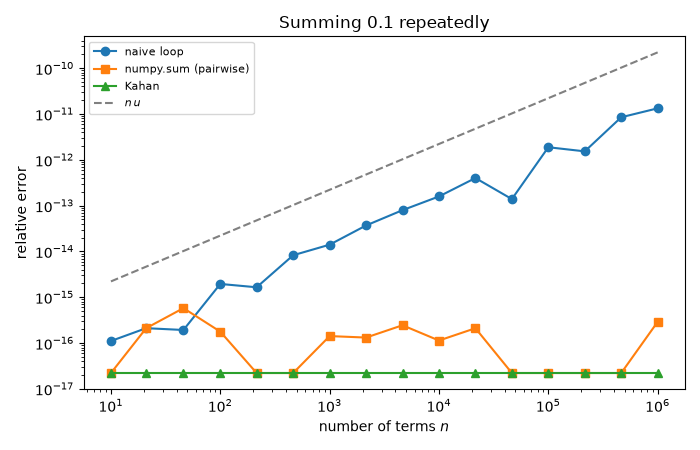
naive loop             n = 1000000: relative error 1.3e-11
numpy.sum (pairwise)   n = 1000000: relative error 2.9e-16
Kahan                  n = 1000000: relative error 2.2e-17
Total running time of the script: (0 minutes 0.242 seconds)
