Note
Go to the end to download the full example code or to run this example in your browser via JupyterLite.
The St. Petersburg paradox#
The game pays \(2^k\) if the first head comes on toss \(k\). Its expected payoff is infinite, so the running average of simulated payoffs never settles; it keeps jumping upward whenever a rare long run of tails occurs. Daniel Bernoulli’s logarithmic utility values the game at a small, finite amount.
import matplotlib.pyplot as plt
import numpy as np

from mathematicskit.probability import st_petersburg_certainty_equivalent, st_petersburg_payoffs
Running average payoff#
n = np.arange(1, 1000001)
fig, ax = plt.subplots()
for seed in range(4):
    payoffs = st_petersburg_payoffs(n.size, seed=seed)
    ax.semilogx(n, np.cumsum(payoffs) / n, lw=1)
ax.semilogx(n, np.log2(n), "k--", label=r"$\log_2 n$ growth")
ax.set_xlabel("games played")
ax.set_ylabel("average payoff")
ax.legend()
ax.set_title("St. Petersburg game: the average never converges")
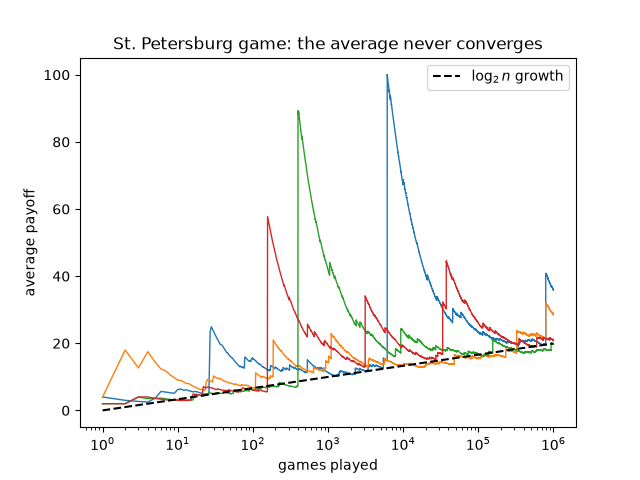
Text(0.5, 1.0, 'St. Petersburg game: the average never converges')
Bernoulli’s certainty equivalent under log utility#
for wealth in (0.0, 10.0, 100.0, 1000.0, 1e6):
    print(f"wealth {wealth:>9.0f}: worth {st_petersburg_certainty_equivalent(wealth):.3f} ducats")
wealth         0: worth 4.000 ducats
wealth        10: worth 5.466 ducats
wealth       100: worth 7.892 ducats
wealth      1000: worth 10.969 ducats
wealth   1000000: worth 20.874 ducats
Total running time of the script: (0 minutes 0.555 seconds)
