
Note
Go to the end to download the full example code or to run this example in your browser via JupyterLite.
Pólya’s theorem: a drunk man finds his way home, a drunk bird may not#
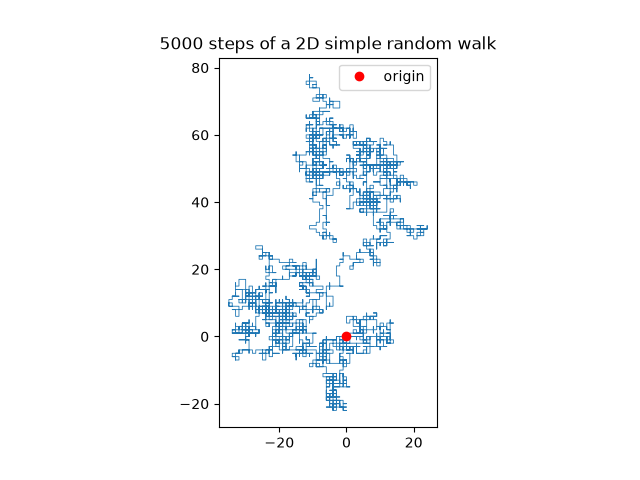
A simple random walk returns to its starting point with probability 1 in one and two dimensions but only about 34% of the time in three. The simulated fraction of walks that have returned by step \(n\) keeps climbing toward 1 in 1D (slowly, like \(1 - 1/\sqrt{\pi n/2}\)), crawls upward in 2D, and levels off near 0.3405 in 3D.
import matplotlib.pyplot as plt

from mathematicskit.probability import random_walk_return_fraction, return_probability_1d, simple_random_walk
A 2D walk#
walk = simple_random_walk(n_walks=1, n_steps=5000, dim=2, seed=3)[0]
fig, ax = plt.subplots()
ax.plot(*walk.T, lw=0.6)
ax.plot(0, 0, "ro", label="origin")
ax.set_aspect("equal")
ax.legend()
ax.set_title("5000 steps of a 2D simple random walk")
Text(0.5, 1.0, '5000 steps of a 2D simple random walk')
Return fractions by dimension#
horizons = [10, 30, 100, 300, 1000]
fig, ax = plt.subplots()
for dim in (1, 2, 3):
    fracs = [random_walk_return_fraction(dim, n, n_walks=4000, seed=dim) for n in horizons]
    print(f"d={dim}: " + ", ".join(f"{f:.3f}" for f in fracs))
    ax.semilogx(horizons, fracs, "o-", label=f"d = {dim} (simulated)")
ax.semilogx(horizons, [return_probability_1d(n) for n in horizons], "k:", label="d = 1 exact")
ax.axhline(0.3405, color="0.5", ls="--", label="d = 3 limit 0.3405")
ax.set_xlabel("steps")
ax.set_ylabel("fraction returned to origin")
ax.legend()
ax.set_title("Pólya (1921): recurrence in d ≤ 2, transience in d = 3")
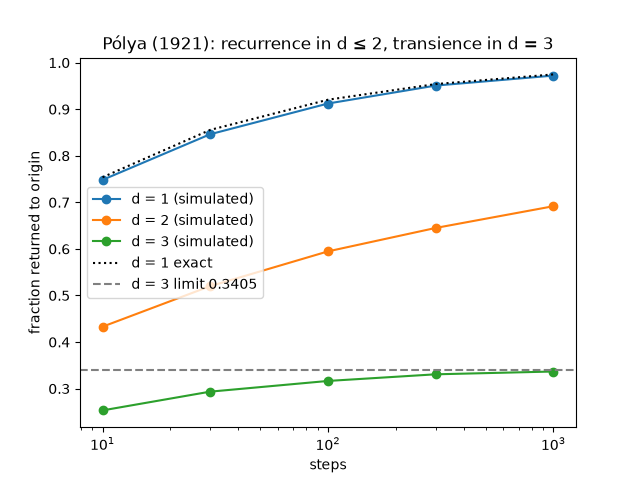
d=1: 0.748, 0.846, 0.912, 0.951, 0.972
d=2: 0.433, 0.520, 0.595, 0.645, 0.692
d=3: 0.253, 0.293, 0.317, 0.331, 0.337

Text(0.5, 1.0, 'Pólya (1921): recurrence in d ≤ 2, transience in d = 3')
Total running time of the script: (0 minutes 0.330 seconds)
