
Note
Go to the end to download the full example code or to run this example in your browser via JupyterLite.
Gauss’s linking number (1833)#
Gauss’s double integral \(\frac{1}{4\pi}\oint\oint \frac{(r_1 - r_2)\cdot(dr_1 \times dr_2)}{|r_1 - r_2|^3}\) counts how many times one closed curve winds around another. It is an integer that no deformation can change without passing one curve through the other. Below: the unlink (0), the Hopf link (\(\pm 1\), the sign set by the orientations), and torus links whose components wind \(n\) times around each other.
import matplotlib.pyplot as plt
import numpy as np

from mathematicskit.topology import linking_number

t = np.linspace(0, 2 * np.pi, 300, endpoint=False)
ring = np.column_stack([np.cos(t), np.sin(t), 0 * t])
links = {
    "unlink": (ring, np.column_stack([3 + np.cos(t), 0 * t, np.sin(t)])),
    "Hopf link": (ring, np.column_stack([1 + np.cos(t), 0 * t, np.sin(t)])),
    "Hopf link, reversed": (ring, np.column_stack([1 + np.cos(t), 0 * t, np.sin(t)])[::-1]),
}


def torus_link(n, phase):
    v = n * t + phase
    return np.column_stack([(2 + np.cos(v)) * np.cos(t), (2 + np.cos(v)) * np.sin(t), np.sin(v)])


for n in (1, 2, 3):
    links[f"(2, {2 * n}) torus link"] = (torus_link(n, 0.0), torus_link(n, np.pi))

for name, (a, b) in links.items():
    print(f"{name:>20}: linking number {linking_number(a, b):+.6f}")
             unlink: linking number -0.000000
          Hopf link: linking number -1.000000
Hopf link, reversed: linking number +1.000000
  (2, 2) torus link: linking number -1.000000
  (2, 4) torus link: linking number -2.000000
  (2, 6) torus link: linking number -3.000000
The links#
fig = plt.figure(figsize=(12, 7))
for i, (name, (a, b)) in enumerate(links.items()):
    ax = fig.add_subplot(2, 3, i + 1, projection="3d")
    for curve, color in ((a, "tab:blue"), (b, "tab:orange")):
        closed = np.vstack([curve, curve[:1]])
        ax.plot(*closed.T, color=color, lw=2)
    ax.set_title(f"{name}: lk = {round(linking_number(a, b))}")
    ax.set_box_aspect((1, 1, 0.6))
    ax.set_axis_off()
fig.suptitle("Gauss (1833): the linking integral is an integer")
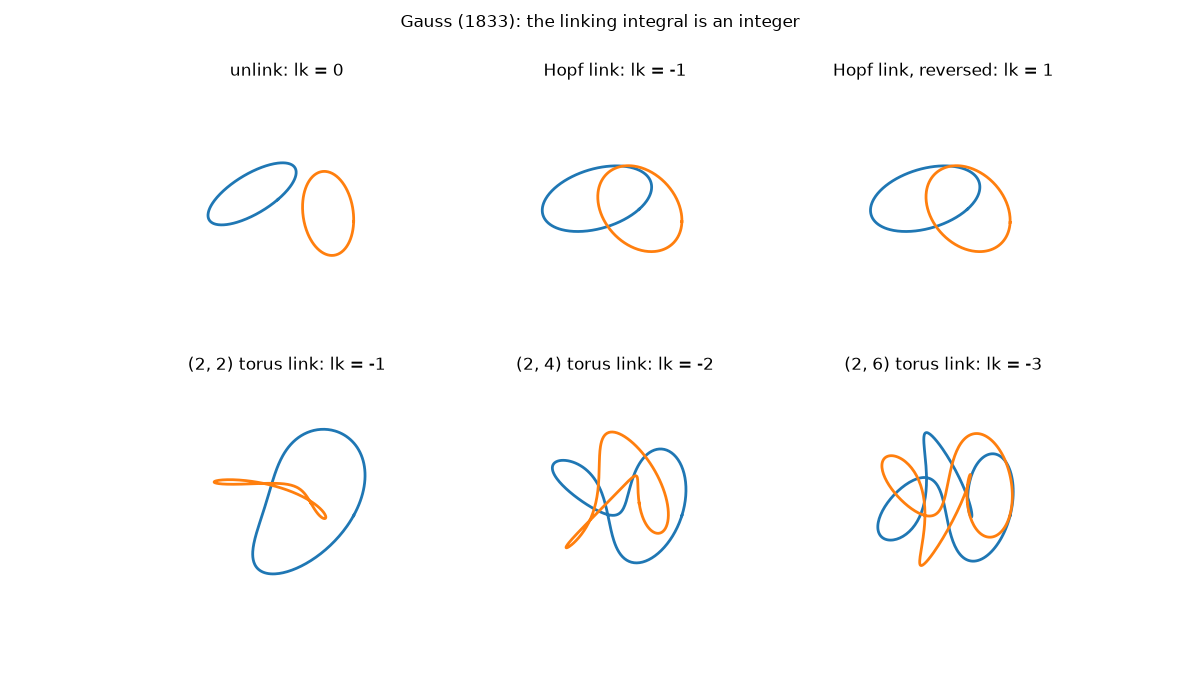
Text(0.5, 0.98, 'Gauss (1833): the linking integral is an integer')
The integrand is a solid angle#
Gauss read the integral as the solid angle swept by the direction from one curve to the other. Refining the polygons barely changes the sum, which stays an integer: it is exact for polygons, not an approximation.
Hopf link with n-gon curves: [-1. -1. -1. -1. -1.]
Total running time of the script: (0 minutes 0.197 seconds)
