
Note
Go to the end to download the full example code or to run this example in your browser via JupyterLite.
Convolutional codes (1955)#
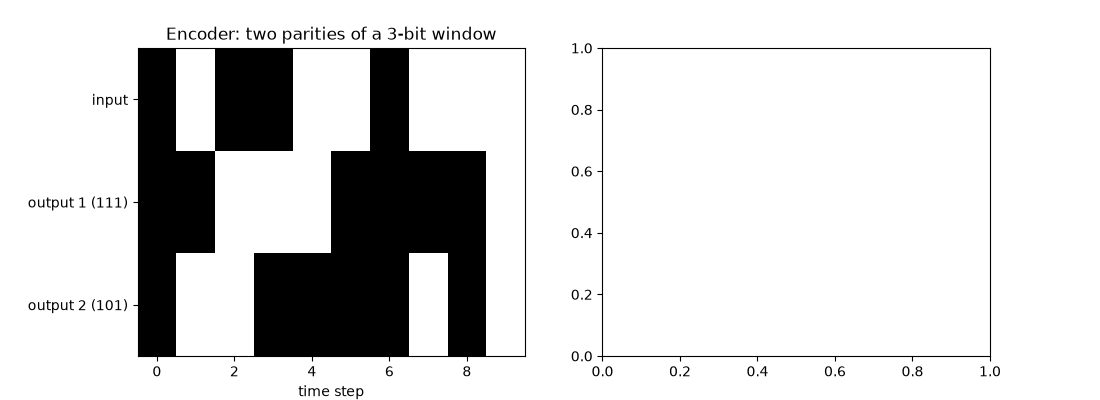
Elias proposed encoding a bit stream continuously instead of in blocks: each output pair is the parity of a sliding window of input bits. The rate-1/2 code with generators \((7, 5)_8\) and constraint length 3 spreads every input bit over six output bits, and its free distance – the lightest nonzero output – is 5.
import itertools

import matplotlib.pyplot as plt
import numpy as np

from mathematicskit.information_theory import convolutional_encode

impulse = convolutional_encode([1])
print("impulse response:", impulse.reshape(-1, 2).tolist())

fig, (ax1, ax2) = plt.subplots(1, 2, figsize=(11, 4))
message = np.array([1, 0, 1, 1, 0, 0, 1, 0])
encoded = convolutional_encode(message).reshape(-1, 2)
ax1.imshow(np.vstack([np.r_[message, 0, 0], encoded[:, 0], encoded[:, 1]]), cmap="Greys", aspect="auto")
ax1.set_yticks([0, 1, 2], ["input", "output 1 (111)", "output 2 (101)"])
ax1.set_xlabel("time step")
ax1.set_title("Encoder: two parities of a 3-bit window")
impulse response: [[1, 1], [1, 0], [1, 1]]

Text(0.5, 1.0, 'Encoder: two parities of a 3-bit window')
The weight spectrum and the free distance#
Output weights of every input starting with 1, up to length 8. The minimum, 5, is the free distance: two channel errors can always be corrected.
weights = [convolutional_encode(m).sum() for L in range(1, 9) for m in itertools.product((0, 1), repeat=L) if m[0]]
values, counts = np.unique(weights, return_counts=True)
ax2.bar(values, counts)
ax2.set_xlabel("output weight")
ax2.set_ylabel("number of inputs")
ax2.set_title(f"Free distance = {min(weights)}")
Text(0.5, 1.0, 'Free distance = 5')
Total running time of the script: (0 minutes 0.031 seconds)
