Note
Go to the end to download the full example code or to run this example in your browser via JupyterLite.
BTC Relay: a Bitcoin light client in an Ethereum contract (2016)#
An Ethereum contract cannot see Bitcoin. BTC Relay let it check Bitcoin
payments the way a light client does: relayers submit block headers, the
contract checks that each links to a stored one and meets its proof-of-work
target, and it follows the chain with the most work. A contract can then
verify that a transaction is in a block of that chain under c
confirmations, with a Merkle proof against the header’s root. Each header
adds expected work
and the relay trusts whichever chain has the most of it, so it is exactly as safe as the work an attacker cannot match.
import matplotlib.pyplot as plt

import blockchainkit as bk
from blockchainkit.contracts import World
from blockchainkit.structures import MerkleTree
Relaying headers and verifying a payment#
world = World()
genesis = bk.channels.mine_header(None, [b"genesis"])
relay = world.deploy("deployer", bk.channels.BTCRelay, genesis, 8, name="BTC Relay")

payment = b"alice pays bob 0.5 BTC"
payloads = [b"coinbase 1", payment, b"carol pays dave"]
headers, gas = [bk.channels.mine_header(genesis, payloads, timestamp=1)], []
for i in range(5):
    headers.append(bk.channels.mine_header(headers[-1], [f"coinbase {i + 2}".encode()]))
proof = MerkleTree(payloads).proof(1)
honest_confirmations = []
for header in headers:
    gas.append(world.transact("relayer", relay, "store_header", header).gas_used)
    honest_confirmations.append(world.view(relay, "confirmations", headers[0].hash))
assert world.view(relay, "verify_transaction", payment, headers[0].hash, proof, 6)
print("gas per header:", gas[0])
gas per header: 41175
Cheap headers are refused, heavier forks win#
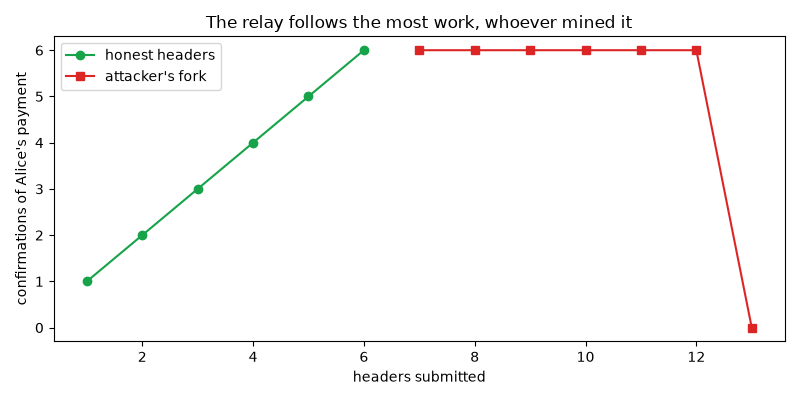
A fork mined at difficulty 2 costs almost nothing and is rejected. A fork at full difficulty that outgrows the honest chain replaces it, and the payment loses its confirmations.
cheap = bk.channels.mine_header(genesis, [b"double spend"], difficulty=2)
assert world.transact("attacker", relay, "store_header", cheap).error == "difficulty too low"
fork = [bk.channels.mine_header(genesis, [b"double spend"], timestamp=2)]
attack_confirmations = []
for i in range(7):
    world.transact("attacker", relay, "store_header", fork[-1])
    attack_confirmations.append(world.view(relay, "confirmations", headers[0].hash))
    fork.append(bk.channels.mine_header(fork[-1], [f"attacker {i}".encode()]))
assert attack_confirmations[-1] == 0
assert not world.view(relay, "verify_transaction", payment, headers[0].hash, proof, 1)

fig, ax = plt.subplots(figsize=(8, 4))
ax.plot(range(1, 7), honest_confirmations, "o-", color="#16a34a", label="honest headers")
ax.plot(range(7, 14), attack_confirmations, "s-", color="#dc2626", label="attacker's fork")
ax.set(xlabel="headers submitted", ylabel="confirmations of Alice's payment")
ax.set_title("The relay follows the most work, whoever mined it")
ax.legend()
fig.tight_layout()

plt.show()
Exercise#
A contract releasing ether against a relayed Bitcoin payment asks for
c confirmations. If an attacker has a fraction q of Bitcoin’s
hashrate, use attacker_success_probability()
to choose c for a payment worth 100 block rewards.
Total running time of the script: (0 minutes 0.087 seconds)
