
Ctrl+K
blockchainkit logo blockchainkit logo
  • Subpackages
  • History
  • Examples
  • API
  • GitHub
  • Subpackages
  • History
  • Examples
  • API
  • GitHub

Section Navigation

  • blockchainkit.crypto
    • Blind signatures
    • Commitments
    • Elliptic curves
    • Discrete logarithms
    • Hash-based signatures
    • Hashing
    • One-time pad
    • Public-key exchange
    • Secret sharing
    • Proofs and signatures
  • blockchainkit.structures
    • Bloom filters
    • Chains and payments
    • Hash chains
    • Ledgers
    • Merkle trees
    • Light clients
    • State commitments
    • Timestamping
    • Transaction identity
    • Unspent outputs
  • blockchainkit.consensus
    • Agreement protocols
    • Attacks and their probabilities
    • Nakamoto consensus
    • Proof of stake
    • Proof of work
  • blockchainkit.network
    • Simulated and logical time
    • Gossip and broadcast
    • Peer graphs
    • Overlays and their attacks
    • Block and transaction relay
    • Replication under partitions
  • blockchainkit.vm
    • Contracts and verification
    • Ethereum
    • Foundations of stack machines
    • Replicated and atomic execution
    • Bitcoin Script
  • blockchainkit.contracts
    • Foundations
    • Governance
    • Paying out
    • Token standards
    • Upgrades and addresses
    • Verification
    • Multisig wallets
  • blockchainkit.economics
    • Auctions and market makers
    • Coordination and oracles
    • Decentralized finance
    • Fee markets
    • Transaction ordering
    • Block rewards
  • blockchainkit.channels
    • Erasure codes and data availability
    • Interoperability
    • Payment and state channels
    • Channel networks
    • Scaling the chain
  • blockchainkit.proofs
    • Polynomials and interactive proofs
    • Probabilistically checkable proofs and arguments
    • Private payments
    • Pairing-based SNARKs
    • Transparent proofs
  • blockchainkit.fraud
    • Fabricated figures
    • Market manipulation
    • Phishing
    • Scam contracts
    • Ponzi schemes
    • Custodians and solvency
  • Examples
  • Examples
  • Ponzi schemes

Ponzi schemes#

Paying old investors with new money, on paper, in contracts, and on lending platforms.
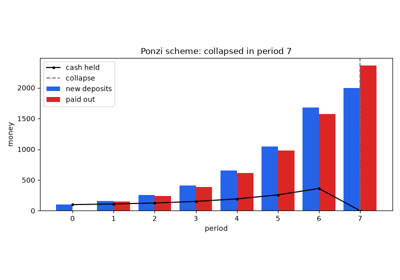
Ponzi’s scheme: paying old investors with new money (1920)

Ponzi's scheme: paying old investors with new money (1920)
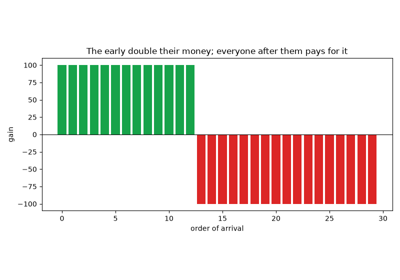
Bartoletti et al.: dissecting Ponzi schemes on Ethereum (2017)

Bartoletti et al.: dissecting Ponzi schemes on Ethereum (2017)
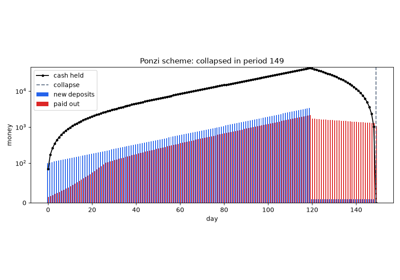
BitConnect and lending-platform Ponzis (2018)

BitConnect and lending-platform Ponzis (2018)

previous

Rug pulls and hidden-mint tokens: the Squid Game token (2021)

next

Ponzi’s scheme: paying old investors with new money (1920)

Show Source

© Copyright 2026, Charles Poli.

Created using Sphinx 9.1.0.

Built with the PyData Sphinx Theme 0.22.0.