
Note
Go to the end to download the full example code or to run this example in your browser via JupyterLite.
BitConnect and lending-platform Ponzis (2018)#
BitConnect took bitcoin deposits into a “lending program” and credited interest of around 1% a day, said to come from a trading bot. Nothing was traded: interest and withdrawals were paid out of new deposits, and recruiters earned commissions down several levels of the investors they brought in. Credited balances compound, so the liabilities grow as
while the cash grows only with new deposits. Texas and North Carolina regulators ordered it to stop in January 2018, deposits dried up, and the platform closed within two weeks; the SEC later charged it with a two-billion-dollar fraud.
import matplotlib.pyplot as plt

import blockchainkit as bk
from blockchainkit.fraud.visualizers import plot_ponzi
Deposits grow, then stop at a regulator’s order#
deposits = [100 * 1.03**day for day in range(120)] + [10.0] * 60
run = bk.fraud.simulate_lending_ponzi(deposits, daily_rate=0.01, withdrawal_rate=0.02)
print(f"collapsed on day {run.collapse}; raised {run.raised:,.0f}, paid out {run.repaid:,.0f}")
print(f"balances credited to investors at the end: {run.owed[-1]:,.0f}")
assert run.collapse is not None and 120 < run.collapse < 180
assert run.cash[-1] == 0 and run.owed[-1] > 0.5 * run.raised  # Owed, with nothing left.

fig, ax = plt.subplots(figsize=(9, 4))
plot_ponzi(run, ax=ax)
ax.set_xlabel("day")
ax.set_yscale("symlog", linthresh=100)
fig.tight_layout()
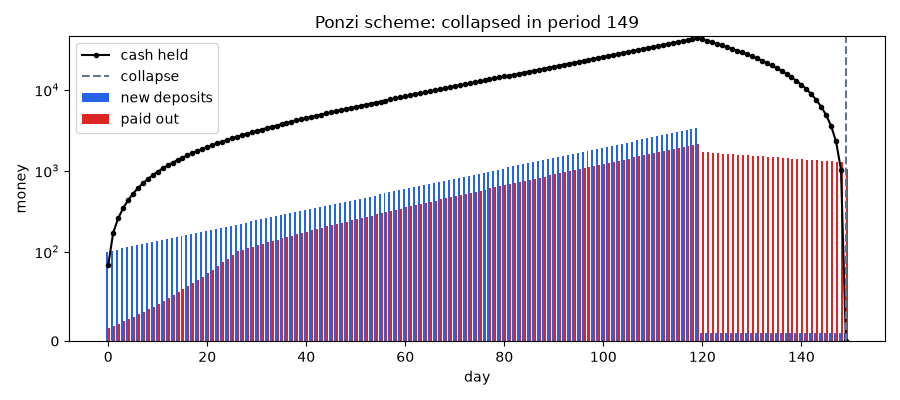
collapsed on day 149; raised 112,670, paid out 112,670
balances credited to investors at the end: 62,168
The referral pyramid#
Each investor recruits two more, three levels deep, and every recruiter earns 7%, 3%, 2% and 1% on the deposits one to four levels below it.
sponsors, deposits_by = {}, {"root": 1_000.0}
level = ["root"]
for _ in range(4):
    nxt = []
    for parent in level:
        for k in range(2):
            child = f"{parent}.{k}"
            sponsors[child] = parent
            deposits_by[child] = 1_000.0
            nxt.append(child)
    level = nxt
commissions = bk.fraud.referral_commissions(sponsors, deposits_by)
by_depth = {}
for name, earned in commissions.items():
    by_depth.setdefault(name.count("."), []).append(earned)
averages = [sum(v) / len(v) for _, v in sorted(by_depth.items())]
print("average commission by depth:", [round(a) for a in averages])
assert averages == sorted(averages, reverse=True)  # The top of the pyramid earns most.

fig, ax = plt.subplots(figsize=(6, 4))
ax.bar(range(len(averages)), averages, color="#9333ea")
ax.set(xlabel="depth in the referral tree", ylabel="commission earned")
ax.set_title("Commissions flow to the top")
fig.tight_layout()

plt.show()
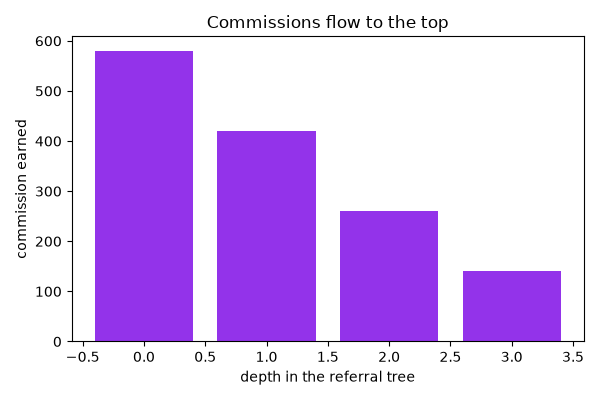
average commission by depth: [580, 420, 260, 140]
Exercise#
With 1% daily interest and no withdrawals, how fast must daily deposits grow for the cash to keep pace with the credited balances? Compare with the breakeven growth of Ponzi’s own scheme.
Total running time of the script: (0 minutes 0.146 seconds)
