
Note
Go to the end to download the full example code or to run this example in your browser via JupyterLite.
Bartoletti et al.: dissecting Ponzi schemes on Ethereum (2017)#
Bartoletti, Carta, Cimoli and Saia collected 184 Ponzi schemes running as Ethereum contracts and sorted them by how they pay. The commonest is the chain: each deposit is queued, owed a multiple of itself, and paid out of later deposits in order of arrival, as in Doubler and Rubixi. Its source is public, and the victims who read it see exactly that:
function enter() payable {
    participants.push(Participant(msg.sender, msg.value * 2));
    owner.transfer(msg.value / 10);
    while (this.balance >= participants[payoutIdx].payout) {
        participants[payoutIdx].etherAddress.transfer(participants[payoutIdx].payout);
        payoutIdx++;
    }
}
Paying \(m\) times every deposit needs the deposits to keep growing, and once they stop, a fraction of about \(1 - 1/m\) of the investors is never paid. A public ledger makes the scheme measurable: the payouts leave in the very transactions that bring in new deposits, and most investors end below what they paid.
import matplotlib.pyplot as plt

import blockchainkit as bk
Thirty investors join a doubler#
world = bk.contracts.World()
investors = [f"investor{k:02}" for k in range(30)]
for name in investors:
    world.fund(name, 1_000)
scheme = world.deploy("owner", bk.fraud.ChainPonzi, 200, 10, name="Doubler")
receipts = [world.transact(name, scheme, value=100) for name in investors]
assert all(r.success for r in receipts)
gains = [world.balance(name) - 1_000 for name in investors]
print("paid in full:", world.view(scheme, "paid"), "of", world.view(scheme, "investors"))
print("owner's take:", world.balance("owner"))
assert sum(g > 0 for g in gains) < len(investors) / 2

fig, ax = plt.subplots(figsize=(8, 4))
colors = ["#16a34a" if g > 0 else "#dc2626" for g in gains]
ax.bar(range(len(gains)), gains, color=colors)
ax.axhline(0, color="black", linewidth=0.8)
ax.set(xlabel="order of arrival", ylabel="gain")
ax.set_title("The early double their money; everyone after them pays for it")
fig.tight_layout()
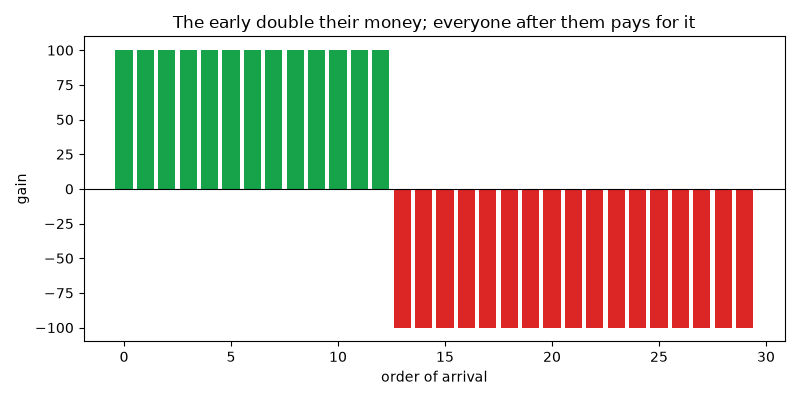
paid in full: 13 of 30
owner's take: 300
What the block explorer shows#
Every payout to an investor leaves in the same transaction as another investor’s deposit, and most investors are in loss: the signature of a Ponzi scheme.
flows = bk.fraud.value_flows(receipts)
features = bk.fraud.ponzi_features(flows, scheme, owner="owner")
print(features)
assert features.looks_like_ponzi and features.paid_from_deposits == 1.0

plt.show()
PonziFeatures(investors=30, in_profit=13, paid_from_deposits=1.0, owner_share=0.10344827586206896)
Exercise#
Change the multiplier to 150%. How many of the 30 investors are now paid, and what does the fraction \(1 - 1/m\) predict? Why does the owner’s fee make the actual number smaller?
Total running time of the script: (0 minutes 0.036 seconds)
