
Note
Go to the end to download the full example code or to run this example in your browser via JupyterLite.
Rug pulls and hidden-mint tokens: the Squid Game token (2021)#
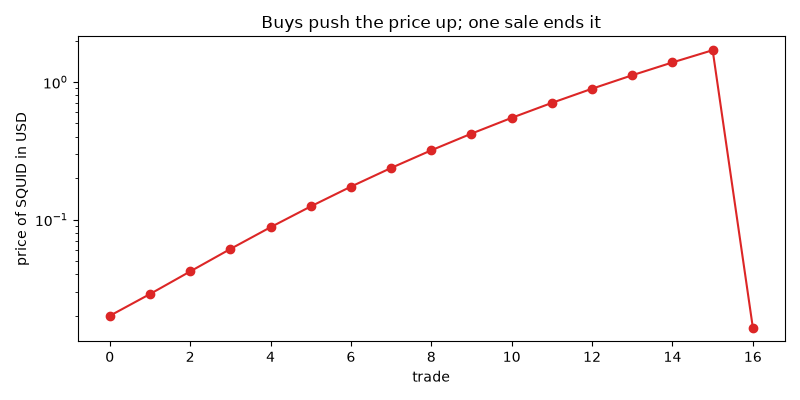
Anyone can issue a token and open a market for it on a decentralized exchange. In November 2021 a token named after the Squid Game series rose from a cent to 2,861 dollars in a week; its buyers could not sell, because the contract refused transfers into the market unless the seller held “marbles”, which nobody could earn. Its creators then sold and vanished, and the price fell to nothing in minutes. The rule hid behind an innocent-looking override, of the kind many scam tokens use:
function _transfer(address from, address to, uint amount) internal override {
    if (to == pair) require(antiDumpExempt[from], "anti-dump");   // no selling
    super._transfer(from, to, amount);
}
On a constant-product market \(xy = k\), whoever can sell when no one else can drains the quote reserve: selling \(\Delta x\) returns \(y \Delta x / (x + \Delta x)\), close to all of \(y\) for a large mint. The defence costs one fork of the chain: buy a little and sell it back before buying for real, as honeypot scanners do.
import matplotlib.pyplot as plt

import blockchainkit as bk
A market for a token only its owner can sell#
world = bk.contracts.World()
usd = world.deploy("bank", bk.contracts.ERC20, 10**8, name="USD")
squid = world.deploy("dev", bk.fraud.SellBlockToken, 10**6, name="SQUID")
world.transact("bank", usd, "transfer", "dev", 10_000)
pool = world.deploy("dev", bk.economics.ConstantProductPool, squid, usd, name="pool")
world.transact("dev", squid, "set_pool", pool)
for asset in (squid, usd):
    world.transact("dev", asset, "approve", pool, 10**6)
world.transact("dev", pool, "add_liquidity", 500_000, 10_000)

print("sell test before buying:", bk.fraud.sell_test(world, pool, squid, usd, "bank", 100))
assert not bk.fraud.sell_test(world, pool, squid, usd, "bank", 100)
sell test before buying: False
Buyers pile in; nobody can leave#
prices = [float(world.view(pool, "price"))]
buyers = [f"buyer{k}" for k in range(15)]
for k, name in enumerate(buyers):
    world.transact("bank", usd, "transfer", name, 2_000 + 500 * k)
    world.transact(name, usd, "approve", pool, 10**6)
    world.transact(name, pool, "swap", usd, 2_000 + 500 * k)
    prices.append(float(world.view(pool, "price")))
stuck = world.view(squid, "balance_of", buyers[0])
world.transact(buyers[0], squid, "approve", pool, stuck)
print("a buyer tries to sell:", world.transact(buyers[0], pool, "swap", squid, stuck).error)
a buyer tries to sell: anti-dump: selling is not enabled
The owner sells everything it kept#
before = world.view(usd, "balance_of", "dev")
world.transact("dev", pool, "swap", squid, world.view(squid, "balance_of", "dev"))
prices.append(float(world.view(pool, "price")))
gain = world.view(usd, "balance_of", "dev") - before
paid_in = sum(2_000 + 500 * k for k in range(15))
print(f"buyers paid {paid_in:,} USD; the owner walked away with {gain:,}")
assert gain > 0.9 * paid_in and prices[-1] < prices[0]

fig, ax = plt.subplots(figsize=(8, 4))
ax.plot(prices, "o-", color="#dc2626")
ax.set(xlabel="trade", ylabel="price of SQUID in USD", yscale="log")
ax.set_title("Buys push the price up; one sale ends it")
fig.tight_layout()

plt.show()
buyers paid 82,500 USD; the owner walked away with 83,400
Exercise#
Replace the sell block with HiddenMintToken.
Does the sell test still warn the buyers? Which check on the token’s
source or its total supply would?
Total running time of the script: (0 minutes 0.040 seconds)
