Note
Go to the end to download the full example code or to run this example in your browser via JupyterLite.
Torres et al.: the Solidity quirks honeypots exploit (2019)#
Four of the honeypot techniques Torres, Steichen and State classified are
quirks of the Solidity language or compiler of the time, which the reader
of the source does not suspect. They are reproduced here by their effect;
nothing is compiled. Inheritance disorder: the child redeclares
owner, so the bidder who becomes owner is not the one the parent’s
modifier checks.
contract Ownable {
    address owner = msg.sender;
    modifier onlyOwner { require(msg.sender == owner); _; }
}
contract KingOfTheHill is Ownable {
    address public owner;
    function() payable { if (msg.value > jackpot) owner = msg.sender; jackpot += msg.value; }
    function takeAll() onlyOwner { msg.sender.transfer(this.balance); jackpot = 0; }
}
Uninitialised storage struct: GuessHistory guessHistory; without
memory points at slot 0, so recording the player’s address overwrites
the “private” number the reader read from storage. Type deduction
overflow: for (var i = 0; i < 2 * msg.value; i++) makes i a
uint8, and the doubled counter wraps at \(2 \cdot 128 \equiv 0
\pmod{256}\), ending the loop with a payout of 254 wei. Skipped empty
string literal: before Solidity 0.4.12, the call
loggedTransfer(amount, "", msg.sender, owner) was encoded without the
"", so the owner received the investor’s refund.
import matplotlib.pyplot as plt

import blockchainkit as bk

world = bk.contracts.World()
world.fund("creator", 20_000)
losses = {}


def victim(name, amount):
    world.fund(name, amount)
    return name
Inheritance disorder#
hill = world.deploy("creator", bk.fraud.KingOfTheHill, name="KingOfTheHill")
world.transact("creator", hill, value=1_000)
king = victim("bidder", 1_500)
world.transact(king, hill, value=1_500)
print(
    "public owner:",
    world.view(hill, "owner"),
    "| takeAll:",
    world.transact(king, hill, "take_all").error,
)
losses["inheritance disorder"] = 1_500 - world.balance(king)
public owner: bidder | takeAll: only the owner
Uninitialised storage struct#
game = world.deploy("creator", bk.fraud.GuessNumber, 7, 100, name="GuessNumber")
world.transact("creator", game, value=1_000)
secret = world.read(game, "number")  # "private" is not secret on a public chain.
guesser = victim("guesser", 100)
world.transact(guesser, game, "guess", secret, value=100)
print("the secret was", secret, "and slot 0 now holds", world.read(game, "number"))
losses["uninitialised struct"] = 100 - world.balance(guesser)
the secret was 7 and slot 0 now holds guesser
Type deduction overflow#
doubler = world.deploy("creator", bk.fraud.ForTest, 1_000, name="For_Test")
world.transact("creator", doubler, value=5_000)
sender = victim("doubler", 2_000)
world.transact(sender, doubler, "test", value=2_000)
print("sent 2,000, got back", world.balance(sender))
losses["type deduction overflow"] = 2_000 - world.balance(sender)
assert world.balance(sender) == 254
sent 2,000, got back 254
Skipped empty string literal#
fund = world.deploy("creator", bk.fraud.DividendDistributor, name="DividendDistributor")
investor = victim("investor", 1_000)
world.transact(investor, fund, "invest", value=1_000)
refund = world.transact(investor, fund, "divest", 1_000)
print("refund paid to:", refund.events[0].fields["target"])
losses["skipped empty string"] = 1_000 - world.balance(investor)

assert all(loss > 0 for loss in losses.values())
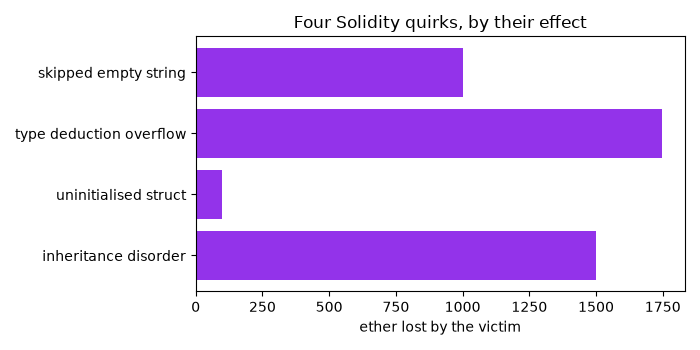
fig, ax = plt.subplots(figsize=(7, 3.5))
ax.barh(list(losses), list(losses.values()), color="#9333ea")
ax.set(xlabel="ether lost by the victim", title="Four Solidity quirks, by their effect")
fig.tight_layout()

plt.show()
refund paid to: creator
Exercise#
In the type-deduction honeypot, what is the largest payout the loop can ever compute, whatever the deposit? Replay the loop by hand for a deposit of 50 wei and explain why the honeypot sets a minimum deposit.
Total running time of the script: (0 minutes 0.030 seconds)
