
Note
Go to the end to download the full example code or to run this example in your browser via JupyterLite.
Torres et al.: honeypot contracts that trap would-be thieves (2019)#
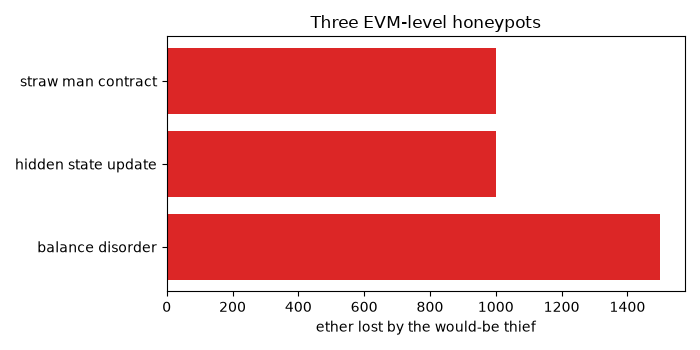
A honeypot holds ether and seems to leak it to anyone who spots a flaw in its source. The reader sends ether to exploit the flaw and loses it. Torres, Steichen and State found 690 honeypots on Ethereum and sorted them by technique. Three rest on EVM semantics or on what the block explorer shows. Balance disorder: the reader sees that sending at least the contract’s balance pays out both,
function multiplicate(address adr) payable {
    if (msg.value >= this.balance) adr.transfer(this.balance + msg.value);
}
but this.balance already includes msg.value, so with any bait
\(b > 0\) the condition \(v \ge b + v\) never holds. Hidden state
update: anyone who pays 1 ether may set the password of a gift box, but its
creator closed the box through a contract call that carried no ether, which
the explorer of the time did not list. Straw man contract: a bank pays
before updating balances, an apparent reentrancy bug, and logs each
cash-out to a Log contract; the address given to the constructor holds
different code that reverts every cash-out but the creator’s.
import matplotlib.pyplot as plt

import blockchainkit as bk

world = bk.contracts.World()
world.fund("creator", 10_000)
losses = {}
Balance disorder#
pot = world.deploy("creator", bk.fraud.MultiplicatorX3, name="MultiplicatorX3")
world.transact("creator", pot, value=1_000)  # The bait.
world.fund("thief1", 1_500)
world.transact("thief1", pot, "multiplicate", "thief1", value=1_500)
losses["balance disorder"] = 1_500 - world.balance("thief1")
assert losses["balance disorder"] == 1_500
Straw man contract#
trap_log = world.deploy("creator", bk.fraud.TrapLog, name="Log")
bank = world.deploy("creator", bk.fraud.PrivateBank, trap_log, name="Private_Bank")
world.fund("thief3", 1_000)
world.transact("thief3", bank, "deposit", value=1_000)
cash_out = world.transact("thief3", bank, "cash_out", 1_000)
print("cash out:", cash_out.success, "| code at the log address:", world.code(trap_log).__name__)
losses["straw man contract"] = 1_000 - world.balance("thief3")
assert not cash_out.success and losses["straw man contract"] == 1_000

fig, ax = plt.subplots(figsize=(7, 3.5))
ax.barh(list(losses), list(losses.values()), color="#dc2626")
ax.set(xlabel="ether lost by the would-be thief", title="Three EVM-level honeypots")
fig.tight_layout()

plt.show()
cash out: False | code at the log address: TrapLog
Exercise#
Before sending ether to the bank, what could the would-be thief have read
on chain to discover the straw man? Write the check with
code().
Total running time of the script: (0 minutes 0.026 seconds)
