
Note
Go to the end to download the full example code or to run this example in your browser via JupyterLite.
ICO exit scams and the DAICO (2017-2018)#
In 2017 initial coin offerings raised billions of dollars for projects that existed only as white papers. Nothing tied the team to the money: once the sale closed, it could withdraw everything and disappear, an exit scam. In December 2017 the SEC’s new Cyber Unit froze the PlexCoin sale, which had promised a 1,354% return within a month. Buterin’s DAICO proposal of January 2018 keeps the ether in the contract and releases it at a tap rate \(\tau\), while contributors may vote to refund what remains:
function withdraw(uint amount) onlyTeam {
    require(withdrawn + amount <= tap * (now - start));
    withdrawn += amount;
    team.transfer(amount);
}
A team that vanishes after time \(t\) then takes at most \(\min(\tau t, \text{raised})\), and the contributors recover the rest.
import matplotlib.pyplot as plt

import blockchainkit as bk
Two sales of 10 million, one with a tap#
RAISE = 10_000_000


def run_sale(tap, days=30):
    world = bk.contracts.World()
    buyers = [f"buyer{k}" for k in range(10)]
    for name in buyers:
        world.fund(name, RAISE // 10)
    sale = world.deploy("team", bk.fraud.TokenSale, tap, name="sale")
    for name in buyers:
        world.transact(name, sale, "buy", value=RAISE // 10)
    taken = []
    for _ in range(days):
        world.advance(seconds=86_400)
        available = world.view(sale, "available")
        if available:
            world.transact("team", sale, "withdraw", available)
        taken.append(world.balance("team"))
    return world, sale, buyers, taken


world, sale, buyers, open_sale = run_sale(tap=0)
print("no tap: team takes", open_sale[0], "on the first day")
assert open_sale[0] == RAISE

TAP = RAISE // (100 * 86_400)  # About 1% of the raise per day.
world, sale, buyers, tapped = run_sale(tap=TAP)
print("tap: team has taken", tapped[-1], "after 30 days")
for name in buyers[:6]:
    world.transact(name, sale, "vote_refund")
for name in buyers:
    world.transact(name, sale, "refund")
recovered = sum(world.balance(name) for name in buyers)
print("contributors recover", recovered)
assert tapped[-1] + recovered == RAISE and recovered > 0.6 * RAISE

fig, ax = plt.subplots(figsize=(7, 4))
days = range(1, 31)
ax.plot(days, open_sale, color="#dc2626", label="no tap: exit scam on day 1")
ax.plot(days, tapped, color="#2563eb", label=f"DAICO tap of {TAP} per second")
ax.set(xlabel="day", ylabel="ether taken by the team")
ax.set_title("A tap bounds what a vanishing team can take")
ax.legend()
fig.tight_layout()

plt.show()
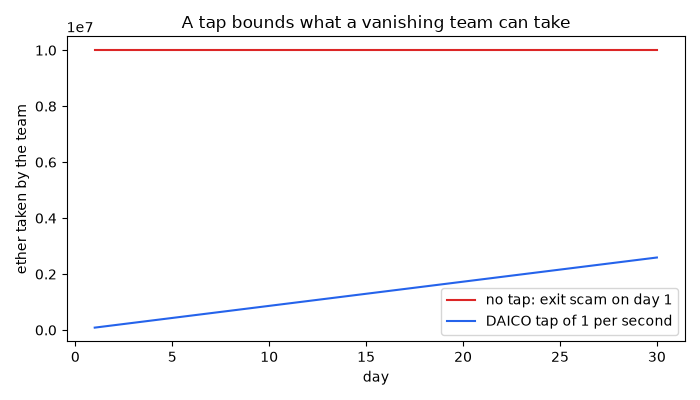
no tap: team takes 10000000 on the first day
tap: team has taken 2592000 after 30 days
contributors recover 7408000
Exercise#
A team with a tap could instead propose raising the tap and vote for it with tokens it bought back cheaply. What share of the tokens must it hold to take everything, and how could a DAICO defend against this?
Total running time of the script: (0 minutes 0.036 seconds)
