Note
Go to the end to download the full example code or to run this example in your browser via JupyterLite.
Verified source code, and why a verified source can still deceive (2016)#
Block explorers let a contract’s author publish its source and verify it: the explorer compiles the source and checks that the bytecode matches the code at the address. Solidity’s metadata hash, added in December 2016, made the match exact, and a green “verified” badge came to read as “safe”. It certifies only which code sits at one address. A buyer who checks the verified source of an upgradeable token reads a proxy:
contract Proxy {
    // keccak256("eip1967.proxy.implementation") - 1
    bytes32 constant IMPLEMENTATION_SLOT = 0x3608...bbc;

    fallback() external payable {
        address impl = StorageSlot.getAddressSlot(IMPLEMENTATION_SLOT).value;
        (bool ok, ) = impl.delegatecall(msg.data);
        require(ok);
    }
}
The behavior lives at whatever address the slot holds, and the admin can change it at any time. The code that runs is
and only the first factor is verified.
import matplotlib.pyplot as plt

import blockchainkit as bk
A verified proxy in front of a plain token#
world = bk.contracts.World()
v1 = world.deploy("dev", bk.fraud.UpgradeableToken, name="token v1")
token = world.deploy("dev", bk.contracts.EIP1967Proxy, v1, name="token")
world.transact("dev", token, "initialize", 1_000_000)
world.transact("dev", token, "transfer", "buyer", 250_000)  # The buyer pays off-chain.
print("verified:", bk.fraud.verify_source(world, token, bk.contracts.EIP1967Proxy))
print("runs:", bk.fraud.effective_code(world, token).__name__)
assert world.transact("dev", token, "seize", "buyer", 1).error is not None  # No such function.
verified: True
runs: UpgradeableToken
The same badge, different code#
v2 = world.deploy("dev", bk.fraud.SeizableToken, name="token v2")
world.transact("dev", token, "upgrade_to", v2)
assert bk.fraud.verify_source(world, token, bk.contracts.EIP1967Proxy)  # Still verified.
print("now runs:", bk.fraud.effective_code(world, token).__name__)
seized = world.transact("dev", token, "seize", "buyer", 250_000)
print("seize:", seized.success, "buyer holds", world.view(token, "balance_of", "buyer"))
assert seized.success and world.view(token, "balance_of", "buyer") == 0

fig, ax = plt.subplots(figsize=(7, 3))
ax.barh(["before the upgrade", "after the upgrade"], [250_000, 0], color=["#16a34a", "#dc2626"])
ax.set(xlabel="buyer's tokens", title="The verified address never changed")
fig.tight_layout()

plt.show()
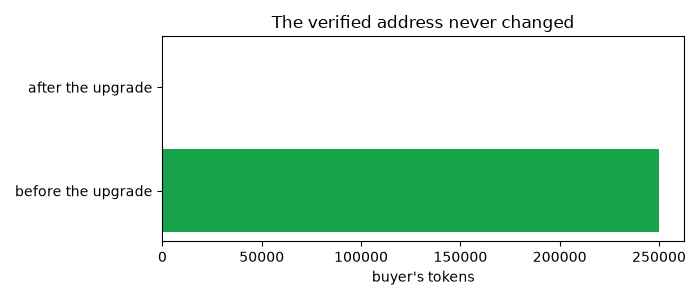
now runs: SeizableToken
seize: True buyer holds 0
Exercise#
List three other ways in which a contract with a verified source can run code its reader never saw. Which of them can a reader detect from the verified source alone?
Total running time of the script: (0 minutes 0.022 seconds)
