Note
Go to the end to download the full example code or to run this example in your browser via JupyterLite.
Balance probing and payment privacy in Lightning (Herrera-Joancomartí et al., 2019)#
Lightning routes a payment over several channels with hash time-locked contracts: each hop forwards the amount minus its fee, with an expiry a margin earlier than the one it was offered. The sender sees every channel’s capacity but not how it is split, which is meant to keep balances, and so payments, private.
Herrera-Joancomartí and co-authors showed that the split leaks. A prober routes a payment through the target channel with a payment hash nobody can claim. If the channel cannot forward the amount, the error comes from it; if it can, the payment fails at the recipient with a different error. No money moves, and a binary search finds the balance of a channel of capacity \(C\) in
A payment across a random channel network#
The sender picks a route by capacity. Here one hop lacks the balance, and its error tells the sender which one: the leak that probing exploits.
graph = bk.network.watts_strogatz(40, 4, 0.2, seed=6)
network = bk.channels.ChannelNetwork.random(graph, capacity=100_000, seed=6)
route = network.find_route(0, 20, 10_000, height=800_000)
attempt = network.send(route)
print("route:", route.nodes, "success:", attempt.success, "failed at:", attempt.failed_at)
assert attempt.error == "temporary_channel_failure"
route: (0, 2, 4, 21, 20) success: False failed at: (21, 20)
Probing forty channels#
The prober opens a well-funded channel to one end of each target channel, then probes it.
edges = graph.edges[:40]
spy_graph = Graph(graph.n + 1, [*graph.edges, *((graph.n, u) for u, _ in edges)])
balances = {}
for u, v in graph.edges:
    balances[u, v], balances[v, u] = network.balance(u, v), network.balance(v, u)
for u, _ in edges:
    balances[graph.n, u], balances[u, graph.n] = 10**9, 0
spy = bk.channels.ChannelNetwork(spy_graph, balances)
true, found, probes = [], [], []
for u, v in edges:
    result = bk.channels.probe_balance(spy, graph.n, u, v)
    true.append(spy.balance(u, v))
    found.append(result.low)
    probes.append(result.probes)
assert found == true and max(probes) <= 17
print(f"{len(edges)} balances found exactly, with at most {max(probes)} probes each")

fig, (left, right) = plt.subplots(1, 2, figsize=(11, 4))
plot_route(route, ax=left)
right.scatter(true, found, color="#dc2626")
right.plot([0, 100_000], [0, 100_000], color="#64748b", linestyle="--")
right.set(xlabel="true balance", ylabel="balance found by probing")
right.set_title(f"Every channel's split, {max(probes)} probes each")
fig.tight_layout()

plt.show()
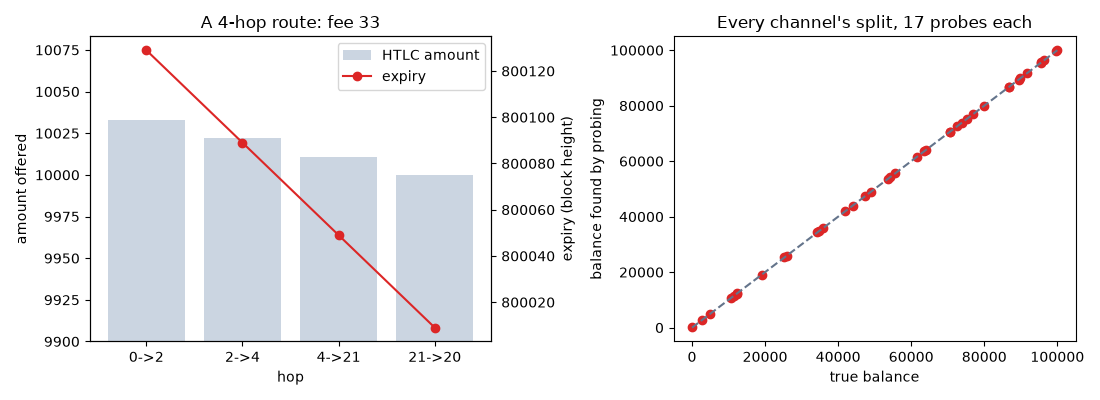
40 balances found exactly, with at most 17 probes each
Exercise#
A node could hide its balance by refusing some payments it could forward,
answering temporary_channel_failure at random. How does that affect
the binary search, and what does it cost honest senders?
Total running time of the script: (0 minutes 0.093 seconds)
