Note
Go to the end to download the full example code or to run this example in your browser via JupyterLite.
Miller’s capabilities: purses, and the tx.origin confused deputy (1997-2006)#
In an object-capability system, the only way to act on something is to hold a reference to it. Mark Miller’s E language built distributed money on this rule: to pay, hand over a purse holding exactly the payment; the recipient can take that and nothing else. There is no ambient authority, no global “who is calling” to consult.
Ambient authority causes the confused deputy (Hardy, 1988): a program
holding authority for one party is tricked into using it for another.
Ethereum’s tx.origin, the account that signed the transaction, is
ambient: a wallet that checks it pays out whenever its owner’s transaction
passes through, even when the owner was lured into calling an attacker’s
contract. Checking msg.sender, the immediate caller, closes the hole.
import matplotlib.pyplot as plt

import blockchainkit as bk
from blockchainkit.contracts.visualizers import plot_call_tree
Paying with a purse#
mint = bk.contracts.Mint("carol-bucks")
alice, bob = mint.make_purse(100), mint.make_purse(0)
payment = alice.sprout()
payment.deposit(25, alice)  # Alice moves 25 into a purse she will hand over.
bob.deposit(25, payment)  # Bob holds only the payment purse...
try:
    bob.deposit(1, payment)
except ValueError as error:
    print("Bob cannot take more:", error)  # ...so he cannot reach Alice's 75.
assert (alice.balance, bob.balance) == (75, 25)
Bob cannot take more: insufficient funds in the source purse
The confused deputy#
theft = {}
for wallet_code in (bk.contracts.OriginWallet, bk.contracts.SenderWallet):
    world = bk.contracts.World()
    world.fund("alice", 100)
    wallet = world.deploy("alice", wallet_code, name="alice's wallet")
    world.transact("alice", wallet, value=100)
    phisher = world.deploy("mallory", bk.contracts.AirdropPhisher, name="airdrop")
    receipt = world.transact("alice", phisher, "claim_airdrop", wallet)
    theft[wallet_code.__name__] = (world, receipt, world.balance("mallory"))
    print(f"{wallet_code.__name__}: Mallory gets {world.balance('mallory')}")
assert theft["OriginWallet"][2] == 100 and theft["SenderWallet"][2] == 0

fig, (top, bottom) = plt.subplots(2, 1, figsize=(9, 4.5))
for ax, name in ((top, "OriginWallet"), (bottom, "SenderWallet")):
    world, receipt, _ = theft[name]
    plot_call_tree(receipt, names=world.name, ax=ax)
    ax.set_title(f"{name}: {ax.get_title()}")
fig.tight_layout()

plt.show()
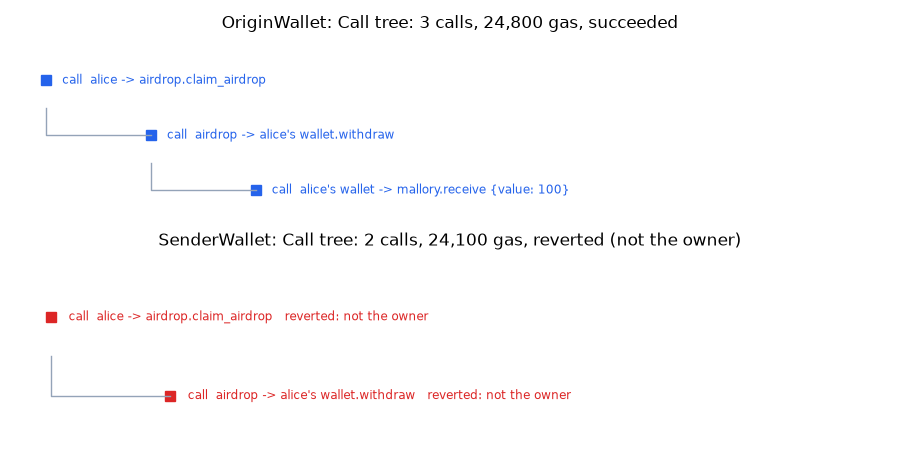
OriginWallet: Mallory gets 100
SenderWallet: Mallory gets 0
Exercise#
SenderWallet still authorizes by identity. Write a wallet contract that
instead pays whoever presents a secret it was given at deployment. Which of
the two designs is closer to a capability, and what new risk does it bring?
Total running time of the script: (0 minutes 0.055 seconds)
