
Note
Go to the end to download the full example code or to run this example in your browser via JupyterLite.
GovernMental: an unbounded loop meets the block gas limit (2016)#
GovernMental was a Ponzi game: the last person to invest before 12 hours of silence won the jackpot. Paying out also reset the game, by clearing the array of creditors, one storage write per entry. In April 2016 the array had grown so long that clearing it needed more gas than a block allowed (about 4.7 million then), so the payout could not execute and roughly 1,100 ether sat stuck in the contract.
The cost of the reset grows linearly with the number of creditors \(n\), and the payout fails once
Any loop over a collection that users can grow is a denial of service waiting to happen. A constant-cost reset, here a new round number instead of deleting old entries, pays out whatever the size.
import matplotlib.pyplot as plt

import blockchainkit as bk
from blockchainkit.contracts.systems.payments import GOVERNMENTAL_TIMEOUT
from blockchainkit.contracts.systems.world import GAS_COSTS
Payout gas against the number of creditors#
BLOCK_GAS_LIMIT = 4_712_388  # Ethereum's block gas limit in early 2016.
sizes = [100, 300, 600, 900, 920, 940, 1_200]


def payout(creditors, lazy):
    world = bk.contracts.World(block_gas_limit=BLOCK_GAS_LIMIT)
    game = world.deploy("operator", bk.contracts.GovernMental, lazy)
    for index in range(creditors):
        world.fund(f"p{index}", 1)
        world.transact(f"p{index}", game, "invest", value=1)
    world.advance(seconds=GOVERNMENTAL_TIMEOUT)
    return world.transact("anyone", game, "payout")


eager = {n: payout(n, lazy=False) for n in sizes}
lazy = {n: payout(n, lazy=True) for n in sizes}
for n in sizes:
    print(
        f"{n:5d} creditors: clear-all {eager[n].gas_used:>9,} gas "
        f"{'ok' if eager[n].success else eager[n].error:10s} new round {lazy[n].gas_used:,} gas"
    )
first_failure = min(n for n in sizes if not eager[n].success)
assert all(r.success for r in lazy.values()) and first_failure == 940
assert (BLOCK_GAS_LIMIT - GAS_COSTS["transaction"]) // GAS_COSTS["write"] < first_failure

fig, ax = plt.subplots(figsize=(7, 4))
ax.plot(
    sizes, [eager[n].gas_used for n in sizes], "o-", color="#dc2626", label="clear every creditor"
)
ax.plot(sizes, [lazy[n].gas_used for n in sizes], "o-", color="#16a34a", label="start a new round")
ax.axhline(BLOCK_GAS_LIMIT, color="#64748b", linestyle="--", label="block gas limit")
ax.set(xlabel="creditors", ylabel="gas used by the payout", title="The payout outgrows the block")
ax.legend()
fig.tight_layout()

plt.show()
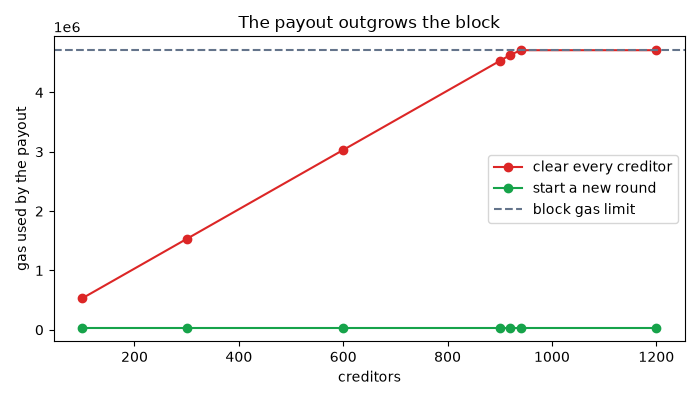
 100 creditors: clear-all   531,500 gas ok         new round 36,500 gas
 300 creditors: clear-all 1,531,500 gas ok         new round 36,500 gas
 600 creditors: clear-all 3,031,500 gas ok         new round 36,500 gas
 900 creditors: clear-all 4,531,500 gas ok         new round 36,500 gas
 920 creditors: clear-all 4,631,500 gas ok         new round 36,500 gas
 940 creditors: clear-all 4,712,388 gas out of gas new round 36,500 gas
1200 creditors: clear-all 4,712,388 gas out of gas new round 36,500 gas
Exercise#
Ethereum’s block gas limit has since grown to 30 million. With this
model’s 5,000 gas per write, how many creditors would it take to freeze
the same contract today? Check your answer with World(), whose default
limit is 30 million. A worked solution is in Exercises: contracts.
Total running time of the script: (0 minutes 0.132 seconds)
