
Note
Go to the end to download the full example code or to run this example in your browser via JupyterLite.
ERC-20 tokens and the approve/transferFrom race (2015)#
Fabian Vogelsteller and Vitalik Buterin’s ERC-20 gave fungible tokens one
interface: transfer, balanceOf, and a two-step delegation, where
approve(spender, n) lets a spender move up to n tokens with
transferFrom. Any wallet or exchange can then handle any token.
approve overwrites the allowance. Suppose Alice allowed Bob 100 and
now wants to lower it to 50. Bob sees her transaction waiting in the
mempool and gets a transferFrom of 100 mined first; her approve
then grants a fresh 50, which he also spends. With the order chosen by the
spender, Alice loses
decrease_allowance changes the allowance relative to what is left, so
if Bob has already spent it, Alice’s reduction reverts instead of granting
more.
import matplotlib.pyplot as plt

import blockchainkit as bk
Alice lowers Bob’s allowance from 100 to 50#
def spent_by_bob(fix, bob_first):
    world = bk.contracts.World()
    token = world.deploy("alice", bk.contracts.ERC20, 1_000)
    world.transact("alice", token, "approve", "bob", 100)
    alice_tx = ("decrease_allowance", "bob", 50) if fix else ("approve", "bob", 50)
    if bob_first:
        world.transact("bob", token, "transfer_from", "alice", "bob", 100)
    world.transact("alice", token, *alice_tx)
    # Bob then spends whatever allowance is left.
    remaining = world.view(token, "allowance", "alice", "bob")
    if remaining:
        world.transact("bob", token, "transfer_from", "alice", "bob", remaining)
    return world.view(token, "balance_of", "bob")


outcomes = {
    (fix, bob_first): spent_by_bob(fix, bob_first)
    for fix in (False, True)
    for bob_first in (False, True)
}
print(outcomes)
assert outcomes[(False, False)] == 50 and outcomes[(False, True)] == 150
assert outcomes[(True, False)] == 50 and outcomes[(True, True)] == 100

fig, ax = plt.subplots(figsize=(7, 4))
labels = ["approve(50)", "decrease_allowance(50)"]
width = 0.35
for offset, bob_first, color in ((-width / 2, False, "#16a34a"), (width / 2, True, "#dc2626")):
    heights = [outcomes[(fix, bob_first)] for fix in (False, True)]
    ax.bar(
        [i + offset for i in range(2)],
        heights,
        width,
        color=color,
        label="Bob front-runs" if bob_first else "in Alice's order",
    )
ax.axhline(100, color="#64748b", linestyle=":", label="what Alice ever allowed at once")
ax.set_xticks(range(2), labels)
ax.set(ylabel="tokens Bob ends with", title="Overwriting an allowance invites a race")
ax.legend()
fig.tight_layout()

plt.show()
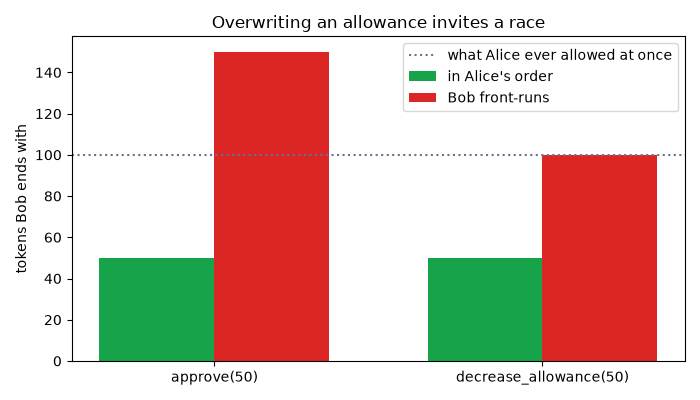
{(False, False): 50, (False, True): 150, (True, False): 50, (True, True): 100}
Exercise#
Another mitigation is to require the allowance to be zero before it is
set to a new nonzero value: Alice approves 0, then 50. Can Bob still take
150? Write the sequence of transactions and check it with World. A
worked solution is in Exercises: contracts.
Total running time of the script: (0 minutes 0.038 seconds)
