Note
Go to the end to download the full example code or to run this example in your browser via JupyterLite.
CREATE2 and counterfactual addresses (2019)#
CREATE derives a new contract’s address from the deployer and its
nonce, so the address depends on everything the deployer did before.
EIP-1014, by Vitalik Buterin, activated in the Constantinople upgrade of
February 2019, added CREATE2:
The address depends only on who deploys, a chosen salt and the code, so it is known before anything is deployed: it is counterfactual. A user can receive funds at a smart-contract wallet that does not exist yet, and the wallet is deployed only when it is first needed, by whoever pays for it. State channels use the same trick for contracts that are deployed only in a dispute.
import matplotlib.pyplot as plt

import blockchainkit as bk
Pay first, deploy later#
world = bk.contracts.World()
factory = world.deploy("dev", bk.contracts.Factory, name="factory")
address = world.view(factory, "predict", 7, "alice")
world.fund("bob", 100)
world.transact("bob", address, value=60)
print("before deployment: code", world.code(address), "balance", world.balance(address))
assert world.code(address) is None and world.balance(address) == 60

deployed = world.transact("relayer", factory, "deploy", 7, "alice").result
assert (
    deployed == address == bk.contracts.create2_address(factory, 7, bk.contracts.Forwarder, "alice")
)
assert world.transact("anyone", address, "sweep").result == 60 and world.balance("alice") == 60
assert "already in use" in world.transact("relayer", factory, "deploy", 7, "alice").error
before deployment: code None balance 60
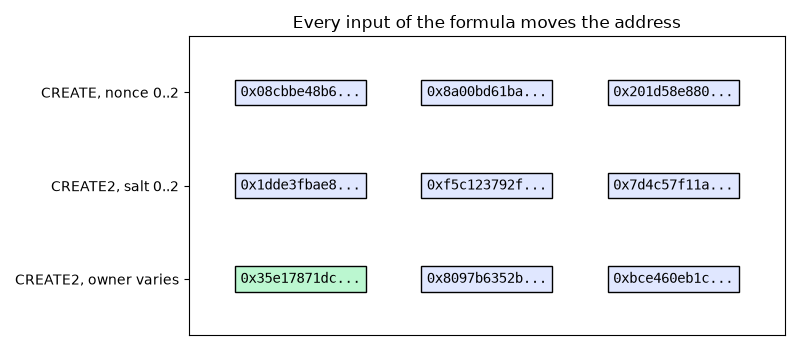
What the address depends on#
creates = [bk.contracts.create_address(factory, nonce) for nonce in range(3)]
salts = [world.view(factory, "predict", salt, "alice") for salt in range(3)]
owners = [world.view(factory, "predict", 7, owner) for owner in ("alice", "bob", "carol")]
assert len(set(creates)) == len(set(salts)) == len(set(owners)) == 3
assert world.view(factory, "predict", 7, "alice") == address  # Reproducible.

fig, ax = plt.subplots(figsize=(8, 3.5))
rows = [
    ("CREATE, nonce 0..2", creates),
    ("CREATE2, salt 0..2", salts),
    ("CREATE2, owner varies", owners),
]
for row, (_, addresses) in enumerate(rows):
    for column, value in enumerate(addresses):
        ax.text(
            column,
            -row,
            value[:12] + "...",
            ha="center",
            va="center",
            family="monospace",
            bbox={"facecolor": "#e0e7ff" if value != address else "#bbf7d0", "pad": 4},
        )
ax.set_yticks([-r for r in range(len(rows))], [label for label, _ in rows])
ax.set(
    xlim=(-0.6, 2.6),
    ylim=(-2.6, 0.6),
    xticks=[],
    title="Every input of the formula moves the address",
)
fig.tight_layout()

plt.show()
Exercise#
The deployed wallet sends everything to its owner. Bob funded Alice’s
address before it existed, trusting that only a Forwarder for Alice can
ever be deployed there. Which inputs of create2_address guarantee
that, and why must the constructor’s argument be part of the code hash?
Total running time of the script: (0 minutes 0.036 seconds)
