
Note
Go to the end to download the full example code or to run this example in your browser via JupyterLite.
MakerDAO’s Dai: a collateralized stablecoin and liquidation (2017)#
A stablecoin aims at a constant price, usually one dollar. Dai is backed not by dollars in a bank but by ether locked in a contract. A user locks ether in a vault and draws newly minted Dai against it, as long as
at the price an oracle reports. If ether falls far enough, anyone may liquidate the vault: repay its Dai, which is burned, and take ether worth the debt plus a 13% penalty. The surplus collateral stays with the owner. The overcollateralization keeps every Dai backed by more than a dollar of ether even after a fall.
The vaults run on the contract world model. Single-Collateral Dai sold the collateral in an auction; here the liquidator buys it at the oracle price.
import matplotlib.pyplot as plt

import blockchainkit as bk
Three vaults and a falling price#
world = bk.contracts.World()
feed = world.deploy("maker", bk.economics.PriceFeed, 400, name="price feed")
engine = world.deploy("maker", bk.economics.VaultEngine, feed, name="vault engine")
dai = world.view(engine, "dai")

vaults = {"cautious": 1_000, "moderate": 2_000, "aggressive": 2_600}
for owner, debt in vaults.items():
    world.fund(owner, 10)
    assert world.transact(owner, engine, "lock", value=10).success
    assert world.transact(owner, engine, "draw", debt).success
    world.transact(owner, dai, "transfer", "keeper", debt)  # Spent; the keeper holds the Dai.
print("a fourth vault drawing too much:", end=" ")
world.fund("greedy", 10)
world.transact("greedy", engine, "lock", value=10)
print(world.transact("greedy", engine, "draw", 2_700).error)
a fourth vault drawing too much: vault would be undercollateralized
The keeper liquidates whatever becomes unsafe#
prices = list(range(400, 99, -20))
supply, backing, liquidated = [], [], {}
for price in prices:
    world.transact("maker", feed, "set_price", price)
    for owner in vaults:
        if owner not in liquidated and not world.view(engine, "is_safe", owner):
            receipt = world.transact("keeper", engine, "liquidate", owner)
            assert receipt.success
            liquidated[owner] = (price, receipt.result)
    supply.append(world.view(dai, "total_supply"))
    locked = sum(world.view(engine, "collateral_of", owner) for owner in vaults)
    backing.append(locked * price)

for owner, (price, seized) in liquidated.items():
    left = world.view(engine, "collateral_of", owner)
    print(f"{owner}: liquidated at {price}, keeper took {seized} ETH, owner kept {left} ETH")
assert set(liquidated) == set(vaults)
assert liquidated["aggressive"][0] > liquidated["moderate"][0] > liquidated["cautious"][0]
assert all(dai_supply <= value for dai_supply, value in zip(supply, backing, strict=True))

fig, ax = plt.subplots(figsize=(7.5, 4.5))
ax.plot(prices, supply, "o-", color="#2563eb", label="Dai in circulation")
ax.plot(prices, backing, "s-", color="#16a34a", label="value of the ether still locked")
for owner, (price, _) in liquidated.items():
    ax.axvline(price, color="#dc2626", linestyle=":")
    ax.annotate(owner, (price, max(backing) * 0.9), rotation=90, ha="right")
ax.invert_xaxis()
ax.set(xlabel="ether price (Dai)", ylabel="Dai")
ax.set_title("Liquidations keep every Dai backed")
ax.legend()
fig.tight_layout()

plt.show()
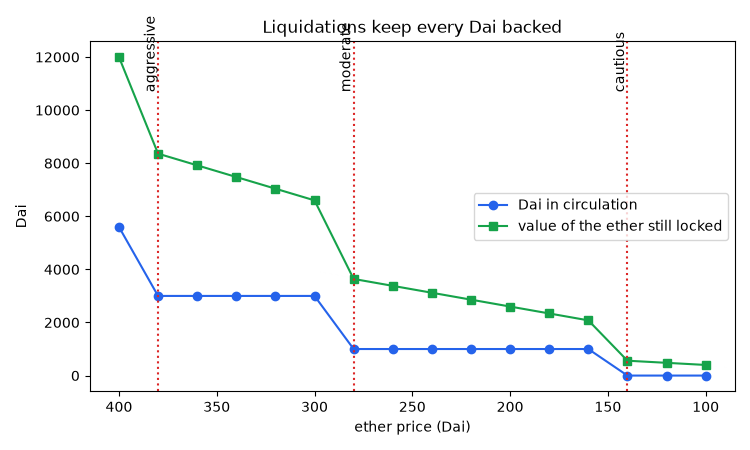
aggressive: liquidated at 380, keeper took 8 ETH, owner kept 2 ETH
moderate: liquidated at 280, keeper took 9 ETH, owner kept 1 ETH
cautious: liquidated at 140, keeper took 9 ETH, owner kept 1 ETH
Exercise#
If the price drops from 400 to 150 in one step, the aggressive vault is liquidated only at 150. Is its debt still covered? Find the price drop within one step at which the keeper would lose money, and explain why Maker later moved to auctions and a larger ratio for volatile collateral. A worked solution is in Exercises: economics.
Total running time of the script: (0 minutes 0.053 seconds)
