
Note
Go to the end to download the full example code or to run this example in your browser via JupyterLite.
EIP-1559: a base fee, burned (2021), and Roughgarden’s analysis (2020)#
Until August 2021, Ethereum sold block space as Bitcoin still does: a first-price auction in which each user names a fee and pays it if included. No bid is obviously right, so users overpay or wait, and the price swings with every burst of demand. EIP-1559 sets a protocol price per unit of gas, the base fee, adjusted after every block toward a target of half the block’s capacity,
which every included transaction pays and which is burned; users add a small tip for the producer. Roughgarden showed that outside sudden rises in demand, offering the base fee plus a tip is optimal, that a myopic producer has no reason to deviate, and that off-chain deals between users and producers cannot beat the protocol, because the base fee goes to nobody.
The simulation sends the same demand, with a surge in the middle, through both mechanisms over a mempool whose users give up after 20 blocks.
import statistics

import matplotlib.pyplot as plt

import blockchainkit as bk
from blockchainkit.economics.visualizers import plot_fee_market
One demand surge, two mechanisms#
TARGET = 20 * 21_000  # Twenty transfers.
arrivals = [20] * 40 + [45] * 40 + [20] * 40
eip1559 = bk.economics.simulate_fee_market(arrivals, gas_target=TARGET, seed=7)
auction = bk.economics.simulate_fee_market(
    arrivals, mechanism="first-price", gas_target=TARGET, seed=7
)

fig, (top, bottom) = plt.subplots(2, 1, figsize=(9, 7), sharex=True)
plot_fee_market(eip1559, gas_target=TARGET, ax=top)
plot_fee_market(auction, gas_target=TARGET, ax=bottom)
fig.tight_layout()
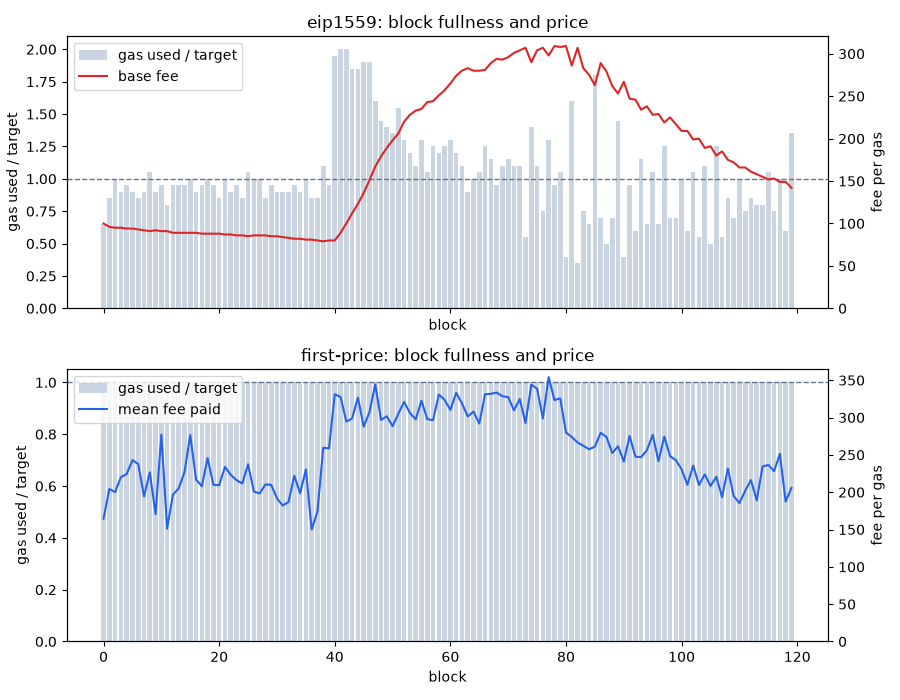
The base fee finds the price at which demand meets the target#
before, during = eip1559.base_fees[39], eip1559.base_fees[79]
print(f"base fee before the surge {before}, at its end {during}")
assert during > 1.5 * before
settled = statistics.mean(eip1559.gas_used[60:80]) / TARGET
print(f"gas used during the surge, once the fee has adjusted: {settled:.2f} x target")
assert 0.8 < settled < 1.2
assert max(eip1559.gas_used) <= 2 * TARGET

burned, tips = sum(eip1559.burned), sum(eip1559.producer_revenue)
print(f"burned {burned:,}, paid to producers {tips:,}")
assert burned > 10 * tips  # The producer gains almost nothing from what users pay.
base fee before the surge 80, at its end 308
gas used during the surge, once the fee has adjusted: 1.07 x target
burned 9,220,176,000, paid to producers 100,128,000
Prices that are easier to predict#
Block to block, the base fee moves by at most 12.5%; the first-price auction’s clearing price jumps with the bids that happen to arrive.
def jumps(prices):
    return [abs(b - a) / a for a, b in zip(prices, prices[1:], strict=False) if a]


paid = [fee + 2 for fee in eip1559.base_fees]
print(
    f"largest jump: EIP-1559 {max(jumps(paid)):.1%}, "
    f"first-price {max(jumps(auction.mean_price)):.1%}"
)
assert max(jumps(eip1559.base_fees)) <= 0.125
assert max(jumps(auction.mean_price)) > max(jumps(paid))

plt.show()
largest jump: EIP-1559 12.1%, first-price 62.5%
Exercise#
A producer considers filling its block with its own transactions to push
the base fee up for the next producers. What does it pay for that, and
who receives it? Use next_base_fee to compute how many full blocks
it takes to double the base fee.
A worked solution is in Exercises: economics.
Total running time of the script: (0 minutes 0.153 seconds)
