
Note
Go to the end to download the full example code or to run this example in your browser via JupyterLite.
Nakamoto’s incentive: block rewards and fees (2008)#
Section 6 of the Bitcoin paper pays whoever creates a block in new coins and in the fees of the transactions it includes. The reward distributes the currency, pays for the work that secures the chain, and, Nakamoto argued, keeps even a powerful miner honest: it “ought to find it more profitable to play by the rules … than to undermine the system and the validity of his own wealth.”
The experiment makes the argument quantitative. A miner of share \(\alpha\) can mine \(m = z + 1\) blocks honestly, earning \(mR\), or spend them on a private chain that reverses a payment of value \(V\) to a merchant waiting \(z\) confirmations. With the catch-up probability \(P_z\) of the whitepaper,
where \(d\) is the fraction of its rewards’ worth the attacker expects to lose if the attack shakes confidence in the coin.
import matplotlib.pyplot as plt
import numpy as np

import blockchainkit as bk
What a block pays#
# The first block after the fourth halving, in April 2024, collected over 37 BTC
# in fees, more than ten times its subsidy; a typical block then paid well under 1 BTC.
COIN = 100_000_000
height = 840_000
subsidy = bk.economics.block_subsidy(height)
for fees in (37 * COIN, COIN // 4):
    reward = bk.economics.block_reward(height, fees)
    print(f"block {height}: subsidy {subsidy / COIN} BTC, reward {reward / COIN:.2f} BTC")
assert bk.economics.block_reward(height, 37 * COIN) > 10 * subsidy
block 840000: subsidy 3.125 BTC, reward 40.12 BTC
block 840000: subsidy 3.125 BTC, reward 3.38 BTC
When a double spend pays#
alphas = np.linspace(0.05, 0.6, 56)
DEVALUATION = 0.5
fig, ax = plt.subplots(figsize=(7.5, 4.5))
for confirmations, color in ((1, "#dc2626"), (3, "#d97706"), (6, "#2563eb")):
    m = confirmations + 1
    breakeven = []
    for alpha in alphas:
        p = bk.economics.double_spend_incentive(
            alpha, reward=1, payment=1, confirmations=confirmations
        ).success_probability
        # The payment, in block rewards, at which attacking and mining honestly tie.
        v = m * (1 - p * (1 - DEVALUATION)) / p
        for factor, pays in ((0.99, False), (1.01, True)):
            result = bk.economics.double_spend_incentive(
                alpha,
                reward=1,
                payment=v * factor,
                confirmations=confirmations,
                devaluation=DEVALUATION,
            )
            assert result.attack_pays == pays
        breakeven.append(v)
    ax.semilogy(alphas, breakeven, color=color, label=f"{confirmations} confirmations")
ax.axvline(0.5, color="black", linestyle=":")
ax.set(xlabel="attacker hashrate alpha", ylabel="payment worth attacking (block rewards)")
ax.set_title("Honest mining pays unless the payment is worth many blocks")
ax.legend()
fig.tight_layout()

small = bk.economics.double_spend_incentive(0.1, reward=3.125, payment=100, confirmations=6)
print(
    f"10% miner, 100 BTC payment: P = {small.success_probability:.1e}, "
    f"attack pays: {small.attack_pays}"
)
assert not small.attack_pays
majority = bk.economics.double_spend_incentive(
    0.6, reward=3.125, payment=5, confirmations=6, devaluation=0.5
)
assert majority.success_probability == 1 and not majority.attack_pays  # Its own wealth at stake.

plt.show()
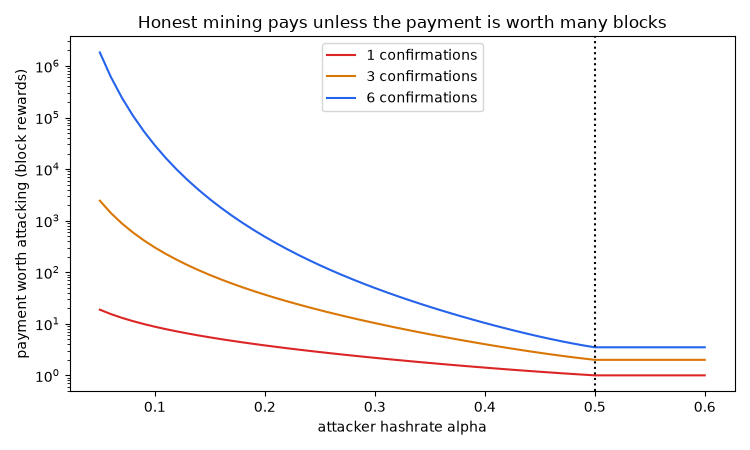
10% miner, 100 BTC payment: P = 2.4e-04, attack pays: False
Exercise#
Without devaluation (d = 0), a majority miner’s attack always pays. How large must the devaluation be for a 60% miner to leave a 5 BTC payment alone, with a 3.125 BTC reward and six confirmations?
Total running time of the script: (0 minutes 0.092 seconds)
