
Note
Go to the end to download the full example code or to run this example in your browser via JupyterLite.
Mining games: when honest mining is an equilibrium (Kiayias et al. 2016)#
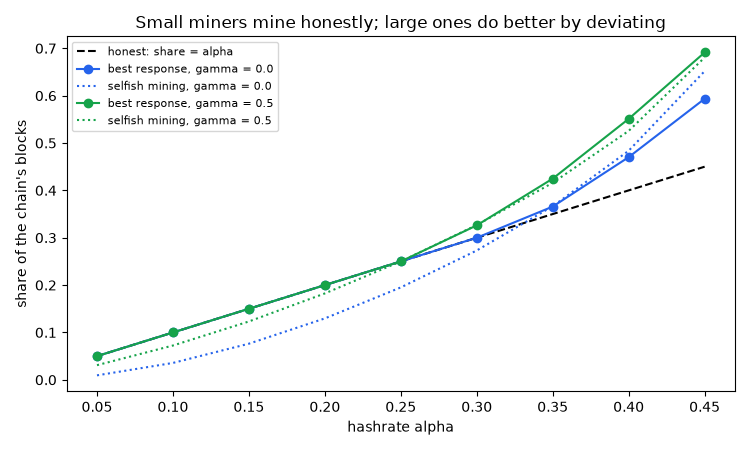
Kiayias, Koutsoupias, Kyropoulou and Tselekounis modeled Bitcoin mining as a stochastic game in which each miner chooses which block to extend and when to publish. Honest mining, extending the longest chain and publishing at once, is the designer’s intended behavior; they showed it is a best response to the others’ honesty when every miner is small, but not for a large one, and that other equilibria then arise.
The experiment computes that best response. Against honest miners, a miner of share \(\alpha\) may withhold blocks, publish them to override or tie the public chain, or give up. As a Markov decision process over the lengths of the private and public branches (Sapirshtein, Sompolinsky and Zohar), its best long-run share of the chain is
and honest mining is an equilibrium exactly when \(\rho^* = \alpha\). Here \(\gamma\) is the fraction of the others who build on its block during a tie.
import matplotlib.pyplot as plt
import numpy as np

import blockchainkit as bk
The best response against honest miners#
alphas = np.round(np.arange(0.05, 0.46, 0.05), 2)
fig, ax = plt.subplots(figsize=(7.5, 4.5))
ax.plot(alphas, alphas, "--", color="black", label="honest: share = alpha")
for gamma, color in ((0.0, "#2563eb"), (0.5, "#16a34a")):
    best = [bk.economics.optimal_mining_revenue(a, gamma, max_lead=8) for a in alphas]
    selfish = [bk.consensus.selfish_mining_revenue(a, gamma) for a in alphas]
    ax.plot(alphas, best, "o-", color=color, label=f"best response, gamma = {gamma}")
    ax.plot(alphas, selfish, ":", color=color, label=f"selfish mining, gamma = {gamma}")
ax.set(xlabel="hashrate alpha", ylabel="share of the chain's blocks")
ax.set_title("Small miners mine honestly; large ones do better by deviating")
ax.legend(fontsize=8)
fig.tight_layout()
Where honesty stops being a best response#
def threshold(gamma, low=0.05, high=0.45):
    while high - low > 0.005:
        middle = (low + high) / 2
        if bk.economics.honest_mining_is_equilibrium(middle, gamma, max_lead=8):
            low = middle
        else:
            high = middle
    return low


for gamma in (0.0, 0.5):
    found = threshold(gamma)
    eyal_sirer = bk.consensus.selfish_mining_threshold(gamma)
    print(
        f"gamma = {gamma}: honest up to alpha ~ {found:.3f} "
        f"(selfish mining pays above {eyal_sirer:.3f})"
    )
    assert found <= eyal_sirer + 0.005

assert bk.economics.honest_mining_is_equilibrium(0.2, 0.0, max_lead=8)
assert not bk.economics.honest_mining_is_equilibrium(0.4, 0.0, max_lead=8)

plt.show()
gamma = 0.0: honest up to alpha ~ 0.331 (selfish mining pays above 0.333)
gamma = 0.5: honest up to alpha ~ 0.250 (selfish mining pays above 0.250)
Exercise#
The model caps both branches at max_lead blocks. Recompute the best
response of a 40% miner with max_lead of 4, 8 and 12. Why can a larger
cap only raise it, and why does it matter more for large miners?
Total running time of the script: (0 minutes 3.711 seconds)
