
Note
Go to the end to download the full example code or to run this example in your browser via JupyterLite.
Provisions: privacy-preserving proofs of solvency (2015)#
Maxwell’s proof reveals the exchange’s total liabilities and, to show its reserves, which addresses it owns. Dagher, Bünz, Bonneau, Clark and Boneh hid both with Pedersen commitments \(C(v, r) = g^v h^r\), which multiply into a commitment to the sum. The exchange commits, for every address in a large public set, to that address’s balance if it owns it and to 0 if not; it commits to every customer’s balance; and
commits to its surplus. Zero-knowledge proofs show that each asset commitment holds 0 or the public balance, that each liability and the surplus are not negative, and nothing else: not the total, not which addresses, not any balance. Each customer, given its blinding factor, checks that its own balance is among the commitments.
import matplotlib.pyplot as plt

import blockchainkit as bk
A solvent exchange proves it#
# Balances of twelve public addresses, four of them the exchange's.
anonymity_set = [820, 40, 1_500, 310, 975, 60, 1_210, 400, 15, 1_830, 700, 95]
owned = {2, 6, 9, 10}
customers = [480, 1_200, 75, 960, 330, 610, 1_025, 290]
prover = bk.fraud.SolvencyProver(anonymity_set, owned, customers, seed=1)
print(f"assets {prover.assets}, liabilities {sum(customers)}, surplus {prover.surplus}")
proof = prover.prove()
assert bk.fraud.verify_solvency(anonymity_set, proof)
assert bk.fraud.verify_liability(proof.liability_commitments[3], customers[3], prover.blinding(3))
print("each liability proof commits to", proof.liability_proofs[0].bits, "bits")
assets 5240, liabilities 4970, surplus 270
each liability proof commits to 16 bits
What the proof does not let the exchange do#
Selling a large address leaves it insolvent: no surplus proof exists. Dropping a customer from the list breaks the arithmetic, and that customer finds its commitment missing.
poorer = bk.fraud.SolvencyProver(anonymity_set, {2, 6, 9}, customers, seed=1)
try:
    poorer.prove()
except ValueError as error:
    print("insolvent exchange:", error)
hidden = bk.fraud.SolvencyProof(
    proof.asset_commitments,
    proof.asset_proofs,
    proof.liability_commitments[1:],
    proof.liability_proofs[1:],
    proof.surplus_proof,
)
assert not bk.fraud.verify_solvency(anonymity_set, hidden)
insolvent exchange: insolvent: no proof of a non-negative surplus exists
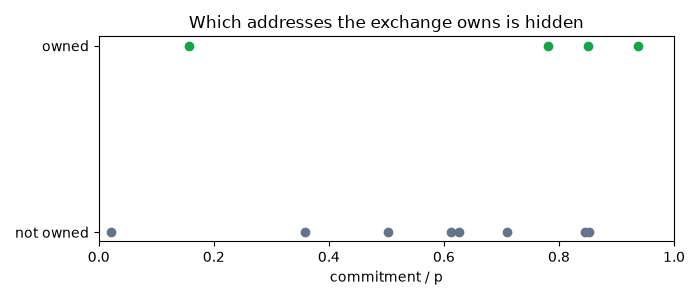
Commitments reveal nothing#
Commitments to an owned address’s balance and to 0 look alike.
owned_c = [c for i, c in enumerate(proof.asset_commitments) if i in owned]
other_c = [c for i, c in enumerate(proof.asset_commitments) if i not in owned]
p = bk.crypto.TEACHING_GROUP.p
fig, ax = plt.subplots(figsize=(7, 3))
ax.scatter([c / p for c in owned_c], [1] * len(owned_c), color="#16a34a", label="owned")
ax.scatter([c / p for c in other_c], [0] * len(other_c), color="#64748b", label="not owned")
ax.set(xlabel="commitment / p", yticks=[0, 1], yticklabels=["not owned", "owned"], xlim=(0, 1))
ax.set_title("Which addresses the exchange owns is hidden")
fig.tight_layout()

plt.show()
Exercise#
Two exchanges could each claim the same address in their own proofs. Why can’t customers of either exchange detect it, and what did Provisions add to rule it out? A worked solution is in Exercises: fraud.
Total running time of the script: (0 minutes 0.042 seconds)
