
Note
Go to the end to download the full example code or to run this example in your browser via JupyterLite.
The Schwartz-Zippel lemma: polynomial identities at random points (1980)#
Are two polynomial expressions the same polynomial? Expanding them can take exponentially many terms. Schwartz, and independently Zippel and DeMillo and Lipton, noticed that a nonzero polynomial of total degree \(d\) has few roots: on a random point of \(\mathbb{F}^n\) it vanishes with probability
So evaluate both sides at a random point. Equal polynomials always agree; different ones disagree, except with probability at most \(d/|\mathbb{F}|\). Every succinct proof system reduces its claim to such a check: the verifier’s random point is where the prover would have to be lucky.
import matplotlib.pyplot as plt

import blockchainkit as bk
from blockchainkit.proofs.visualizers import plot_field_polynomials
Two cubics that agree at three points#
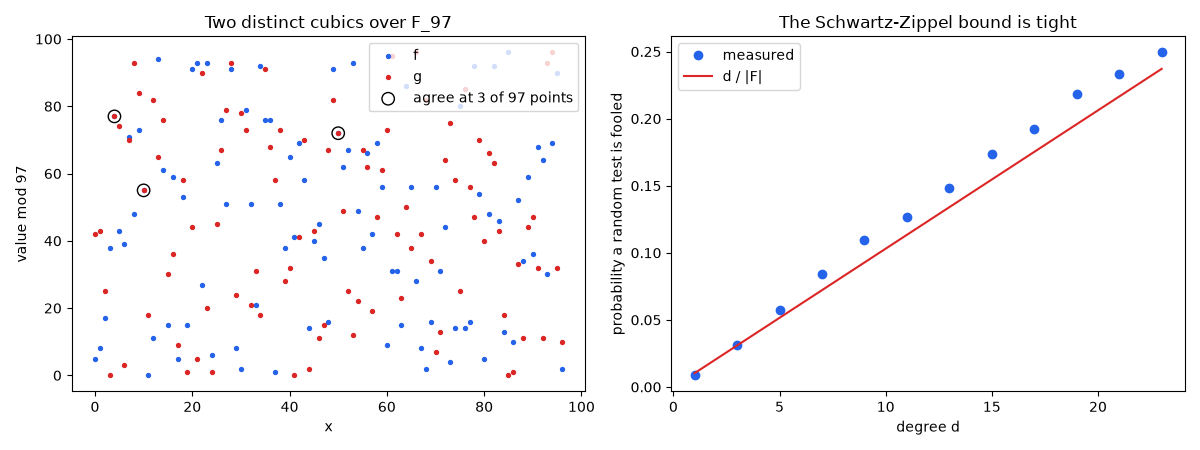
Over the field of 97 elements, g is f plus a cubic with roots 4, 10
and 50, so the two agree there and nowhere else.
f and g agree at [4, 10, 50]
The false-acceptance rate is exactly the fraction of roots#
A product of d distinct linear factors has d roots, the most a degree-d polynomial can have, so a random test accepts it as zero with probability exactly d/97.
degrees = range(1, 25, 2)
measured = []
for d in degrees:
    roots = bk.proofs.vanishing_polynomial(range(1, d + 1), P)
    tests = [
        bk.proofs.identity_test(
            lambda v, r=roots: bk.proofs.poly_eval(r, v[0], P), lambda v: 0, 1, P, seed=s
        ).equal
        for s in range(1500)
    ]
    measured.append(sum(tests) / len(tests))
    assert abs(measured[-1] - d / P) < 0.03
print("degree 23: accepted", measured[-1], "of the time; bound", round(23 / P, 3))
degree 23: accepted 0.24933333333333332 of the time; bound 0.237
A large field makes the test reliable#
Over BabyBear, about 2**31 elements, a wrong expansion of (x + y)**8 is caught with probability above 1 - 8 / 2**31.
def binomial(v):
    return (v[0] + v[1]) ** 8


def correct(v):
    return sum([1, 8, 28, 56, 70, 56, 28, 8, 1][k] * v[0] ** k * v[1] ** (8 - k) for k in range(9))


def typo(v):
    return correct(v) + v[0] ** 4 * v[1] ** 4  # One coefficient 71 instead of 70.


assert bk.proofs.identity_test(binomial, correct, 2, trials=10).equal
assert not bk.proofs.identity_test(binomial, typo, 2).equal
print("bound over BabyBear:", bk.proofs.schwartz_zippel_bound(8, bk.proofs.FIELD_PRIME))

fig, (ax1, ax2) = plt.subplots(1, 2, figsize=(12, 4.5))
plot_field_polynomials({"f": f, "g": g}, P, ax=ax1)
ax1.set_title("Two distinct cubics over F_97")
ax2.plot(degrees, measured, "o", color="#2563eb", label="measured")
ax2.plot(degrees, [d / P for d in degrees], color="#dc2626", label="d / |F|")
ax2.set(xlabel="degree d", ylabel="probability a random test is fooled")
ax2.set_title("The Schwartz-Zippel bound is tight")
ax2.legend()
fig.tight_layout()

plt.show()
bound over BabyBear: 3.973642983052312e-09
Exercise#
Over the field of 97 elements, how many independent random points are needed before two distinct polynomials of degree 10 agree on all of them with probability below one in a million? A worked solution is in Exercises: proof systems.
Total running time of the script: (0 minutes 0.267 seconds)
