
Note
Go to the end to download the full example code or to run this example in your browser via JupyterLite.
Shamir’s IP = PSPACE: proving a quantified formula (1990)#
Interactive proofs can do much more than NP. Shamir showed that they capture all of PSPACE, whose complete problem is deciding a fully quantified Boolean formula such as \(\forall x_1 \exists x_2 \forall x_3 \, \varphi\). Arithmetize \(\varphi\), and turn each quantifier into an operator on polynomials:
The prover peels the operators off one at a time, as in sum-check. Each product doubles the degree, so Shen’s simplification inserts the linearization \(L_i f = (1 - x_i) f|_{x_i=0} + x_i f|_{x_i=1}\) after every quantifier, which agrees with \(f\) on bits and keeps every polynomial the prover sends of degree at most two (or the degree of \(\varphi\)).
import matplotlib.pyplot as plt

import blockchainkit as bk
A true formula, and a prover who claims otherwise#
For all x1, there is an x2 that differs from it, and for all x3 … the matrix is satisfiable whichever way the universal players move.
formula = bk.proofs.CNF(4, ((1, 2), (-1, -2), (3, 4, 2), (-3, -4, -2), (1, 3, 4)))
qbf = bk.proofs.QBF("AEAE", formula)
print("the formula is", qbf.evaluate())
honest = bk.proofs.tqbf_protocol(qbf, seed=2)
liar = bk.proofs.tqbf_protocol(qbf, claim=1 - honest.true_value, seed=2)
print(f"{len(honest.rounds)} rounds; honest accepted {honest.accepted}, liar {liar.accepted}")
assert honest.accepted and not liar.accepted
the formula is True
14 rounds; honest accepted True, liar False
Linearization keeps the degrees small#
raw = bk.proofs.tqbf_protocol(qbf, seed=2, linearize=False)
assert raw.accepted and raw.max_degree > honest.max_degree
print("largest degree sent: with linearization", honest.max_degree, "without", raw.max_degree)

fig, (ax1, ax2) = plt.subplots(1, 2, figsize=(12, 4.5), gridspec_kw={"width_ratios": [3, 1]})
labels = [f"{r.operator}{r.variable}" for r in honest.rounds]
ax1.bar(range(len(labels)), [len(r.polynomial) - 1 for r in honest.rounds], color="#2563eb")
ax1.set_xticks(range(len(labels)), labels)
ax1.set(xlabel="operator, outermost first", ylabel="degree sent", title="With linearization")
ax2.bar(
    [f"{r.operator}{r.variable}" for r in raw.rounds],
    [len(r.polynomial) - 1 for r in raw.rounds],
    color="#dc2626",
)
ax2.set(title="Quantifiers only")
fig.tight_layout()

plt.show()
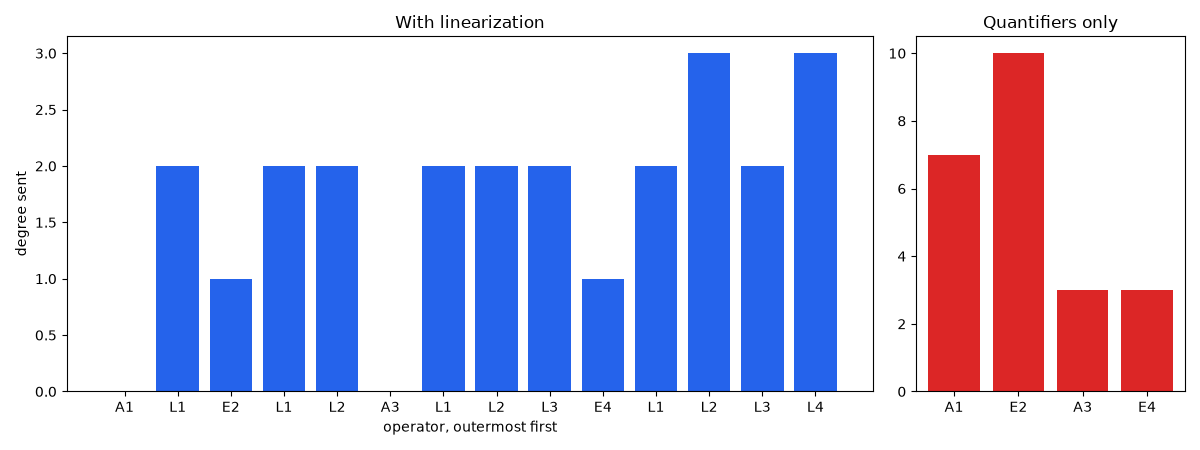
largest degree sent: with linearization 3 without 10
Exercise#
Over the field of 13 elements, how often does a prover claiming the wrong value convince the verifier? Compare with the bound: rounds times degree, divided by 13.
Total running time of the script: (0 minutes 0.057 seconds)
